Clarice Cliff’s May Avenue pattern is a stunning reflection of her growth as a designer and her ability to blend various artistic influences into her ceramic pieces. Introduced in 1933, May Avenue captures the essence of the Art Deco movement and the beauty of the natural world while showcasing her evolution as an artist. This feature delves into the history, techniques, and inspirations of Clarice Cliff’s Most Expensive Pattern May Avenue.
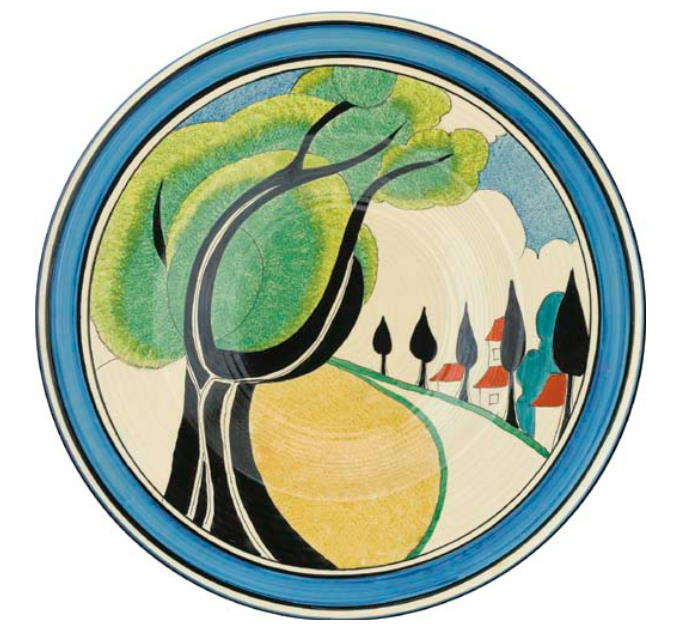
The May Avenue pattern has consistently achieved high prices at auction with a charger being sold at Christies in 2003 for £39,950 and another charger sold at Fieldings Auctioneers in 2009 for £20,500. A Lotus Jug featuring the pattern sold for £8,200 in 2022 and most shapes with the pattern sell for between £1,000-£3,000.
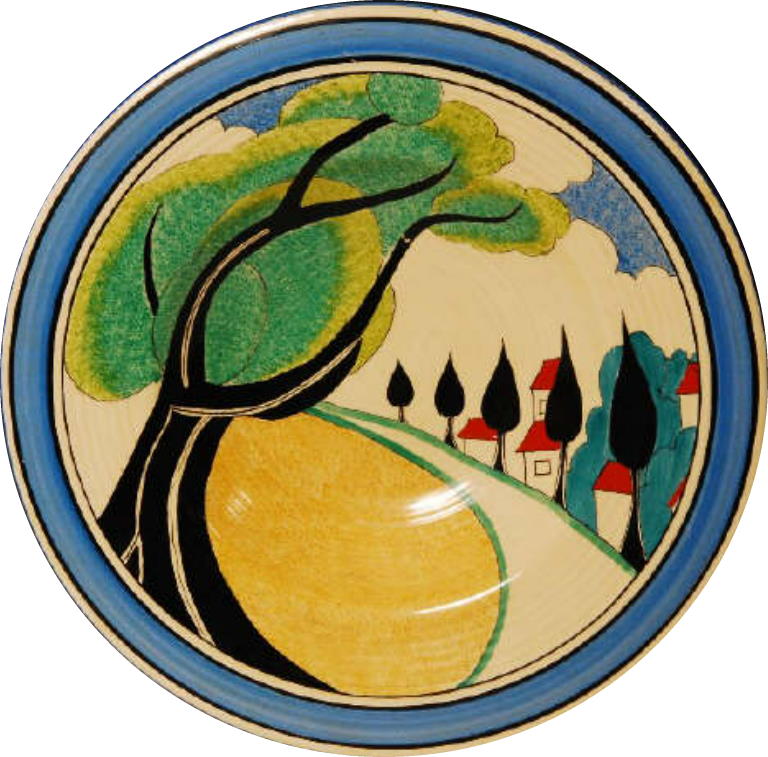
The Evolution of May Avenue
By 1933, Clarice Cliff had already made a name for herself in the world of ceramics with her bold and innovative designs. The paintresses at the Wilkinson Royal Staffordshire Pottery had become adept at interpreting her vision, and the introduction of finer ‘pencil’ brushes allowed for greater detail and precision in her work. This newfound ability to combine multiple painting techniques on a single piece paved the way for the creation of the May Avenue pattern.
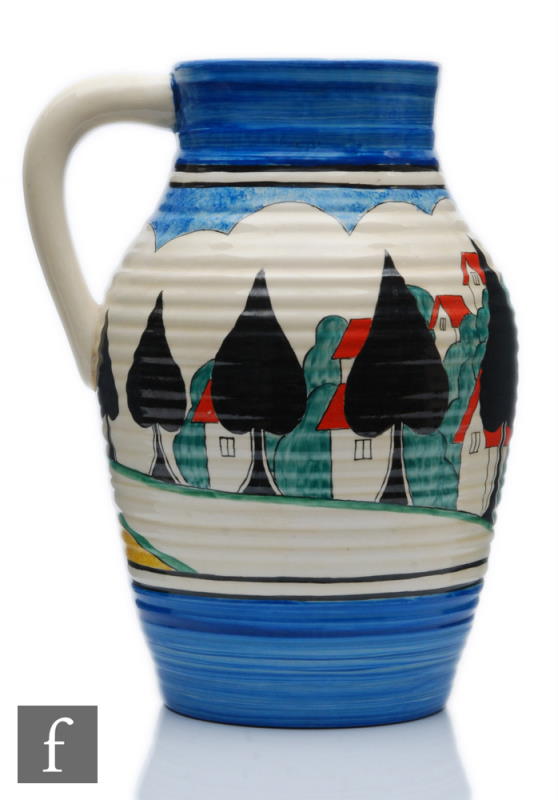
The May Avenue pattern demonstrates Cliff’s mastery of various painting techniques. The flowing trees are created using a mix of outline, enameling, and Cafe Au Lait style stippling, achieved with a special stippling brush. This complex approach gives the pattern its unique appearance and intricate details.
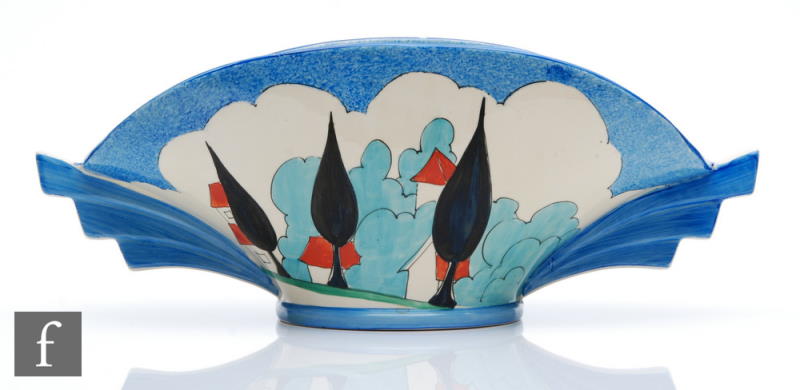
After experimenting with pastel shades in 1931-32, Cliff returned to using stronger colors for May Avenue. The pattern features an unusual vivid blue for the banding and sky, along with a copper-colored blue for the bushes. These striking colors, combined with the intricate painting techniques, make May Avenue a standout design in her portfolio.
Inspirations and Artistic Influences
The genesis of the May Avenue pattern can be traced back to an oil painting Landscape at Cagnes (Cagnes Landscape) by Italian artist Amedeo Modigliani. She drew inspiration the Modigliani oil painting, showcasing her ability to transform fine art concepts into her own unique pottery designs. This incorporation of high-art influences highlights her journey from her humble Staffordshire roots to becoming a celebrated designer in the world of ceramics.
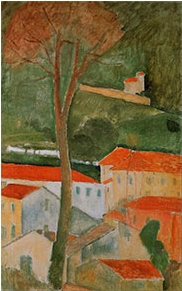
While the May Avenue pattern represents the pinnacle of Clarice Cliff’s artistic development, the name of the pattern connects her back to her origins. The pattern’s name was inspired by a road located just a few streets away from her birthplace in Tunstall, Stoke-on-Trent. The May Avenue pattern by Clarice Cliff is a remarkable display of her artistic growth, technique, and ability to fuse various influences into her work. As a perfect representation of her skills, May Avenue remains a beloved and sought-after pattern by collectors and enthusiasts alike.
Wedgwood have issued the May Avenue pattern on a number of modern pieces including small charger and conical sugar sifter. So if you see a May Avenue piece at a flea market or auction be sure to check the back stamp for the Bizarre mark.
Clarice Cliff related
A look at Clarice Cliff
Related Collectibles on eBay
 Clarice Cliff Bizarre Oceanic Jug Applique 'Seven Colour Secrets'
£550.00
Clarice Cliff Bizarre Oceanic Jug Applique 'Seven Colour Secrets'
£550.00
 Clarice Cliff 5 Pieces ( offers considered )
£464.68
Clarice Cliff 5 Pieces ( offers considered )
£464.68
 A Clarice Cliff bowl in GARDENIA pattern.
£240.00
A Clarice Cliff bowl in GARDENIA pattern.
£240.00
 Clarice Cliff
£13.06
Clarice Cliff
£13.06
 Clarice Cliff 9"/23cm Plate/shallow bowl bizarre Crayon scenes #3
£23.20
Clarice Cliff 9"/23cm Plate/shallow bowl bizarre Crayon scenes #3
£23.20
 30 Pieces of mixed Clarice Cliff cans, bowls, lids, saucers, pots patterns .
£771.69
30 Pieces of mixed Clarice Cliff cans, bowls, lids, saucers, pots patterns .
£771.69
 Clarice Cliff Bizarre Melon Cup and Saucer
£44.38
Clarice Cliff Bizarre Melon Cup and Saucer
£44.38
 A Clarice Cliff George shape jug in MOONFLOWER pattern
£350.00
A Clarice Cliff George shape jug in MOONFLOWER pattern
£350.00
eBay listings may contain affiliate links. We may earn a commission from qualifying purchases.