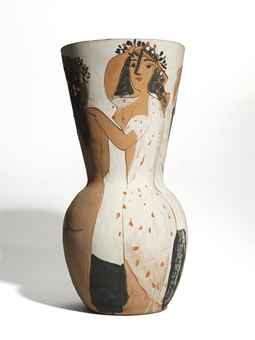
 The two-day auction of Picasso Ceramics: The Madoura Collection on 25 and 26 June 2012 was 100% sold, realising £8,082,300 / $12,584,141 / €10,046,298 – more than four times pre-sale expectations (estimate: £1,789,800 – £2,689,750). The auction offered 543 lots, including many ceramics which had remained untouched since they were created, as well as prints, posters, photography and furniture from the Pottery, presenting the last ever opportunity for collectors to purchase these works by Picasso directly from where they were made, at the Madoura Pottery in Vallauris, France.
Nearly 500 clients registered to bid in the sale which lasted more than 13 hours in total, and buyers were from 43 different countries. The top lot of the sale was Grand vase aux femmes voilées by Pablo Picasso (1881-1973). Conceived in 1950 and executed in an edition of 25 the work sold for more than ten-times the pre-sale estimate, realizing £735,650 / $1,145,407 / €914,413. This is a new world record price for a Picasso ceramic edition at auction. The previous world record price for a Picasso ceramic edition at auction was €312,750 / $414,073 achieved for an edition of Grand vase aux danseurs sold at an auction in December 2010.
The owner of the collection, Alain Ramié, was a friend and colleague of Picasso’s for many years, the author of the catalogue raisonné of Picasso ceramic editions, and the son of the owners of the Madoura Pottery, Georges and Suzanne Ramié. The Ramié family first inspired Picasso to enter into the world of pottery in 1946, the beginning of a fascination that would last until the final years of his life.
India Phillips, and Michelle McMullan, Co-Heads of Sale and Specialists in Impressionist and Modern Art, commented, “It has been a complete pleasure to be a part of the historic sale of The Madoura Collection, offering over 500 Picasso ceramics sourced directly from the Madoura Pottery. The response from collectors has been immense, as demonstrated by the impressive results, with some lots commanding bids from more than 20 collectors. Working with Alain Ramié on the catalogue and sale has been an unforgettable experience, and his passion has been reflected in the bidding over the last two days. The extraordinary results exceed the pre-sale estimate by more than four times and are testament to Picasso’s skill and craftsmanship in all media, as well as his popularity the world over.”
Picasso, Madoura and the Ramié Family
Pablo Picasso was famously first made aware of the Madoura Pottery in 1946, whilst visiting the annual ceramics festival in Vallauris in the South of France. Enchanted by the works on display from the Madoura Pottery, he asked to be introduced to the creators, Georges and Suzanne Ramié, who invited him to see their workshop in action. Picasso was immediately inspired, and modelled three clay pieces that day. A year later, he returned to see his finished works and was delighted with what he had achieved in this new medium and could not resist getting to work with the clay once more. A section of the workshop was set aside for Picasso, who sat with the workers, diligently creating and experimenting with new techniques.
During the 1940s Villauris became an important hub for potters and artisans, and the romantic Picasso enjoyed returning to the simple life of the artisan, and being treated as just another worker by the Ramié’s. He embraced the simple, working life, out of the spotlight, and with his pet owl and goat for company: both animals became favoured motifs in hisoeuvre at this time. The simplicity of Vallauris was in great contrast to Picasso’s international celebrity status, and he was visited there by some of the great names of the late 20th century such as Marc Chagall, Jean Cocteau, Brigitte Bardot, Gary Cooper and Richard Attenborough, many of whom he demonstrated his technique to and was inspired by in turn. The Madoura Pottery held a very special place in Picasso’s heart and greatly impacted upon his life – not only did he meet his second wife, Jacqueline Roque, at Madoura (where she was a pottery assistant), but he spent twenty-four years there experimenting and perfecting his ceramic techniques. Between 1947 and 1971 Picasso produced 633 different plates, bowls, vases and pitchers, in limited editions ranging from 25 to 500.
Growing up in the presence of Picasso, publishing the recognised source on the ceramic editions, and running the Madoura Pottery for many years have all given Alain Ramié unique first-hand experience of Picasso’s life and work. Christie’s specialists India Phillips and Michelle McMullan arrived to meet Alain at the Madoura Pottery in Vallauris on a bright August day in 2011. The preparations had been extensive, but nothing could have prepared them for the sight they discovered there – shelf after shelf of untouched Picasso ceramic masterpieces, mapping out his creative journey over twenty-four years. It took Christie’s almost a week to carefully wrap the many pieces, whilst taking in the incredible atmosphere of the place. The small workshop has remained unchanged since Picasso first visited in the 1940s, which adds to the magic of these untouched editor’s examples. Picasso mastered each medium he turned his hand to, and the inimitable witticism he worked into clay produced some of the most creative and recognisable ceramics of the 20th century.
Related Collectibles on eBay
 Christie's Auction Catalog : Picasso Ceramics The Madoura Collection June 2012
£53.76
Christie's Auction Catalog : Picasso Ceramics The Madoura Collection June 2012
£53.76
 Christie's South Kensington: Picasso Ceramics The Madoura Collection, June 2012
£67.19
Christie's South Kensington: Picasso Ceramics The Madoura Collection, June 2012
£67.19
 Picasso, Pablo. Christie's. Picasso. Ceramics. The Madoura Collection. 2012. Ill
£134.39
Picasso, Pablo. Christie's. Picasso. Ceramics. The Madoura Collection. 2012. Ill
£134.39
 Pablo Picasso ceramic pitcher - jug Terre de faience. 1956, Madoura Gallery
£6,086.70
Pablo Picasso ceramic pitcher - jug Terre de faience. 1956, Madoura Gallery
£6,086.70
 Picasso Ceramics The Attenborough Collection McCully Raeburn Hardcover Book
£39.99
Picasso Ceramics The Attenborough Collection McCully Raeburn Hardcover Book
£39.99
eBay listings may contain affiliate links. We may earn a commission from qualifying purchases.