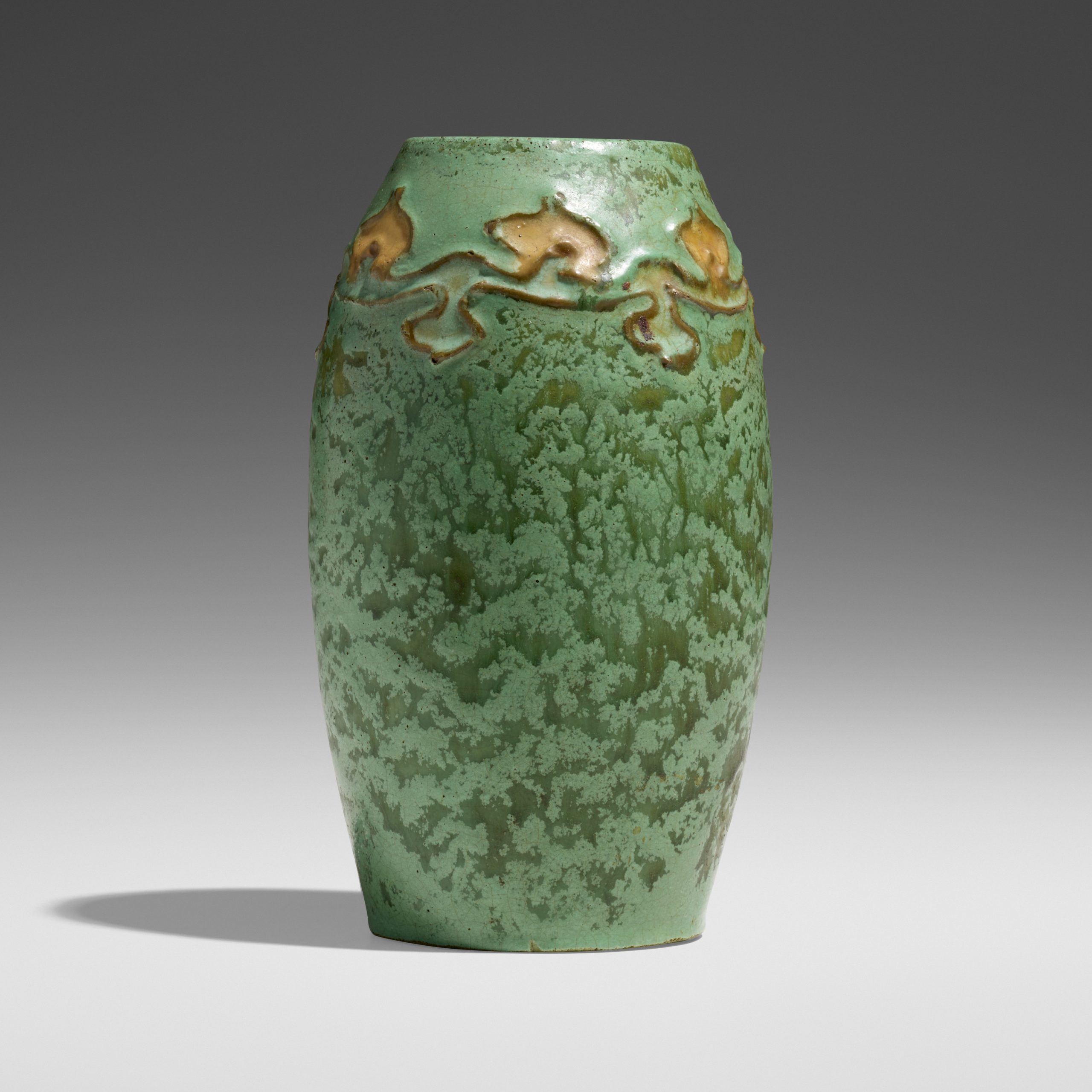
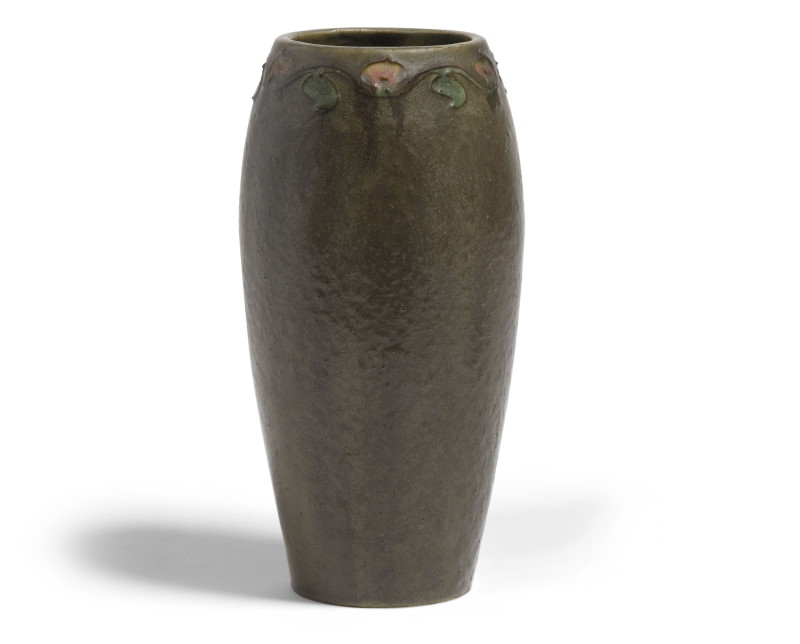
glazed squeezebag-decorated earthenware
6½ h × 3¾ dia in (17 × 10 cm). Sold for $11,970 at Rago Auctions, May 2023.
Brown believed that meaningful work could aid recovery, both physically and emotionally. To that end he established a pottery workshop where female patients could learn ceramic skills. The pottery was named Arequipa, after a Peruvian city whose name translates as “place of rest.” Participation in the pottery programme was voluntary, and patients were paid for their work or had the cost of their treatment partially offset.
The pottery quickly became associated with the ideals of the Arts and Crafts movement, emphasising handmade craftsmanship, simplicity of form, and harmony with nature. Many of the pieces produced at Arequipa are modest in scale, typically small bowls, vases, and vessels finished in subtle matte glazes. The aesthetic is often restrained, with minimal decoration that highlights the surface of the clay and the beauty of the glaze.
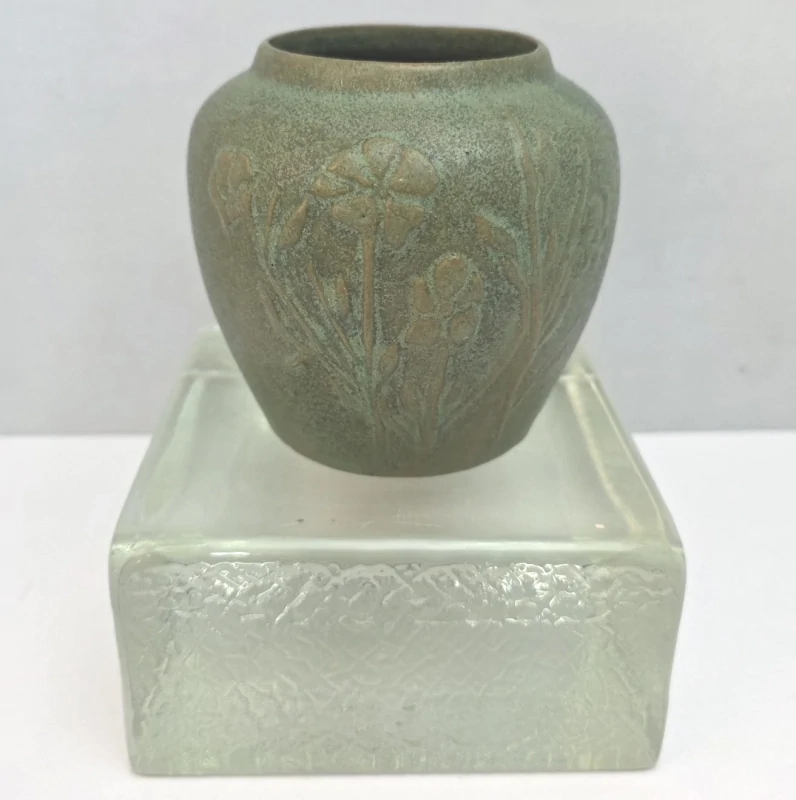
Early Arequipa pottery attracted attention from dealers throughout California and along the West Coast. By 1912 the work being produced by patients under professional supervision was widely regarded as both technically accomplished and aesthetically appealing. The pottery gained further recognition when pieces were exhibited at the Panama-Pacific International Exposition in San Francisco in 1915, where Arequipa wares received both gold and bronze medals.
Despite its success, the pottery remained a relatively small enterprise. Most vessels are simple in design and often feature a single glaze colour, frequently matte or softly textured. Later work sometimes included moulded or carved decoration, but the earliest pieces are typically understated and elegant. The pottery remained active into the mid-1910s before gradually declining.
Frederick Hurten Rhead and His Influence
Central to the artistic identity of Arequipa Pottery was the English-born ceramicist Frederick Hurten Rhead (1880–1942), who was hired by Dr. Brown to establish and direct the pottery in 1911. Rhead came from a long line of Staffordshire potters and had already built a distinguished career in the United States, working for major ceramic firms such as Avon Faience, Weller, and Roseville.
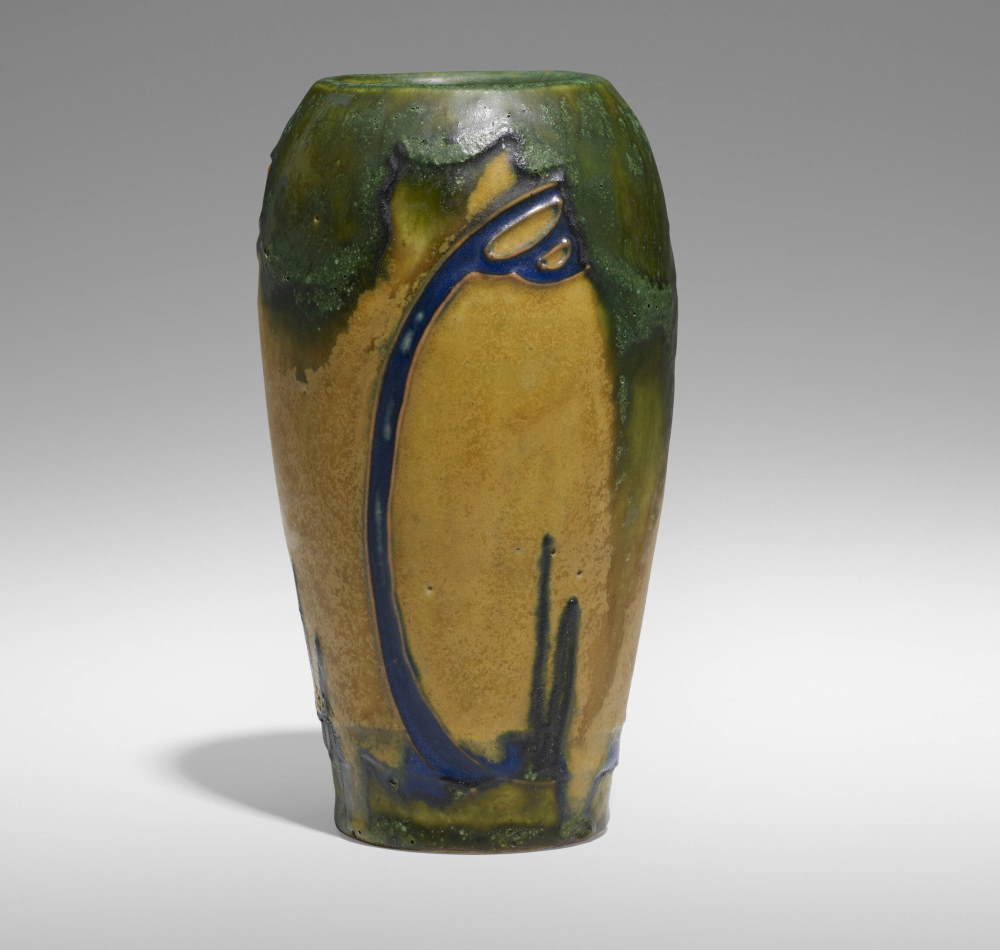
Rhead was not only a designer but also a teacher, author, and technical innovator. One of the techniques he introduced to American ceramics was squeeze-bag decoration, a process in which liquid clay is applied through a tube or bag to create raised slip-trailed designs on the surface of pottery. This technique became one of the defining decorative features of his work and appeared on several early Arequipa pieces.
At Arequipa, Rhead simplified his designs so that patients could reproduce them. Rather than covering entire vessels with complex ornament, he often limited decoration to a few carefully placed leaves, berries, or abstract motifs applied near the rim. These restrained designs reflected the influence of the emerging California Arts and Crafts aesthetic, which valued subtlety and balance rather than elaborate decoration.
Although Rhead’s tenure at Arequipa lasted only until 1913, his influence on the pottery was profound. His vision helped establish the studio’s artistic direction and its reputation for carefully crafted ceramics. After leaving Arequipa, Rhead continued a distinguished career that culminated with the design of the famous Fiesta dinnerware line for the Homer Laughlin China Company in 1935, one of the most successful American ceramic designs ever produced.
Later Production and Artistic Legacy
Following Rhead’s departure, the pottery was directed by Albert Solon, the son of renowned ceramic artist Marc-Louis Solon of Sèvres and Minton. Solon expanded the range of glazes and introduced new decorative techniques, including Persian-inspired finishes. Later director Frederick H. Wilde introduced Hispano-Moorish tile production, which became an important part of the pottery’s output.
Most collectors, however, place the greatest value on pieces produced during the Rhead period (1911–1913). These works typically bear marks either incised into the clay or hand-painted in blue on a white ground.
Museum Collections and Auction Market
Examples of Arequipa Pottery are held in several important museum collections, reflecting its significance in the development of American studio ceramics. Works attributed to the pottery can be found in the collections of the Metropolitan Museum of Art in New York, the Oakland Museum of California, and the Smithsonian American Art Museum, where they are studied within the context of the Arts and Crafts movement in California.
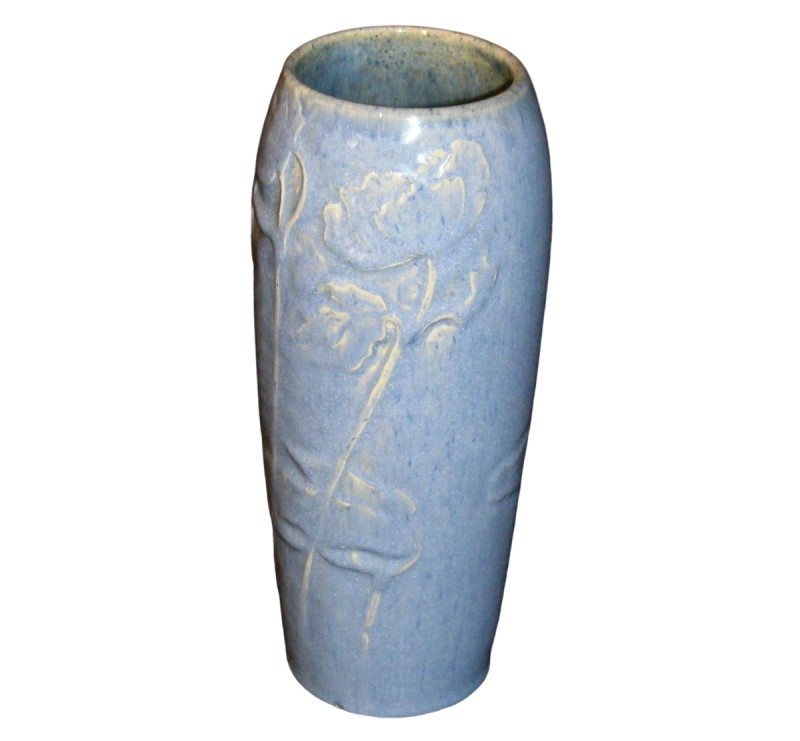
1912 with firm’s marks in blue glaze, numbered ‘569’. Sold for US$20,075 inc. premium at Bonhams, Los Angeles, Modern Design | Art – Part 1, May 2020.
At auction, the market for Arequipa pottery remains relatively specialised but has strengthened as interest in early twentieth-century American art pottery continues to grow. Simple monochrome pieces may sell for a few hundred pounds or dollars, while well-decorated works by Rhead or rare forms can reach $2,000–$10,000 or more at specialist art pottery sales. Exceptional examples with distinctive slip-trail decoration or documented Rhead attribution occasionally achieve even higher prices.
Today Arequipa Pottery is admired not only for its craftsmanship but also for the remarkable story behind its creation. Combining therapeutic purpose, artistic innovation, and the influence of one of the twentieth century’s most versatile ceramic designers, the pottery represents a unique and compelling chapter in American decorative arts.
Related
Discovering the History and Legacy of Roseville Pottery