 The
The
story of British aristocracy’s love affair with Chinese
Armorial Porcelain which transformed life in manor houses two
centuries ago lies at the heart of a sale of Chinese Armorial
wares at Bonhams on June 20th at New Bond Street.
Today one pops down to the local departmental store to buy
a dinner service – a rather different process from the two year
saga that took ships halfway round the world in the18th and
19th centuries to bring back new 300 piece services. This was
a journey which left the ocean floors thinly spread with Chinese
porcelain – while impatient would-be owners of fine dinner services
waited back in England.
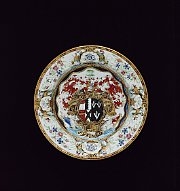
Aristocrats and wealthy merchants commissioning porcelain from
China often requested that it be emblazoned with the family’s
arms. The Coats Collection is a remarkable survey of the range
of private people who followed this splendidly decorative opportunity
of family branding and status.
 This
This
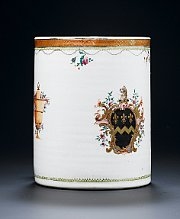
sale of the unique Coats Collection, created by an American
couple with a love of Chinese porcelain is estimated to sell
for over £500,000. Exotic Chinese armorial porcelain enriched
generations of mahogany-panelled English-taste country-house
interiors for over three centuries, and still connects people
across the world – the Coats Collection is the proof.
‘Chinese Armorial’ porcelain – that is, Chinese
porcelain specially commissioned by a Western patron to be painted
in China with his personal coat-of-arms – formed an extremely
small, but artistically significant element of China Trade shipping
cargoes.
This stunning porcelain represented a social revolution in
England, affecting the way people ate, entertained and even
the way they designed their homes including separate dining
rooms – no longer eating in great halls – allowing this
lavish crockery to be shown off to best effect.
This specially commissioned crested porcelain was shipped to
Europe from China’s main port Canton, from about 1720 to
1830 by the famous English East India Company.
British supremacy at sea coincided with booming economic success
in England, as agricultural and industrial innovations spawned
unimagined wealth at many levels of society, which was often
recycled rapidly into creature comforts and conspicuous consumption.
Few things were more conspicuous for a newly married, newly
rich businessman than a 300-piece dinner service boldly enamelled
with the conjoined family arms of the owner and his spouse!
Aristocratic families across Europe were buyers but nothing
compared with the British market. Today we can identify some
4,000 different insignia, initials and coats-of-arms on Chinese
Export commissioned for UK clients; yet another 2,000 remain
to be identified, and even in 2005 scholars were still finding
one or two unrecorded ones a week.
A new way of entertaining
This new, confident society in ‘Augustan’ (early
18th century) England represented an opportunity for considerable
change in the way individuals entertained. After the political
and social disruption of the mid/late 17th century, English
society appreciated the opportunity again to build fine houses;
to fill them with modish accessor ies, in decorative schemes
popularised by designers like the émigré French
Huguenot Daniel Marot; and generally to upgrade the quality
of ‘polite’ behaviour, in ranks of society way below
Court and aristocratic grandee level. There are allusions everywhere
in the histories and diaries of the period. Porcelain itself
becomes popular, a novel substitute for cut flowers during winter
months; offering innovatory design possibilities for emancipated
‘ladies of the house’ to dress their Withdrawing rooms
and leaven a rich, dark baroque interior.
New exotic imports revolutionised cuisine, including spices
from Java, from the Moluccas, from India; while market gardens
around London, and a vague new awareness that fruit and vegetables
were actually good nutrition, saw fruit compotes and salads
served more often as the 18th century progressed. These new,
more imaginative fuller-flavoured cuisines, requiring new vessels
in which to serve them, were paralleled by the invention of
delicacies served in specially designed silver and porcelain
small vessels – sorbets, jellies, and custards. And above
all, three new imports transformed the way hosts (and particularly
hostesses) treated their guests. From the late 17th century,
three caffeine-rich but alcohol-free imports came to require
massive quantities of porcelain serving vessels, as a very wide
spectrum of Western society felt confident to offer and serve
chocolate, coffee and tea.
LECTURE ON CHINESE ARMORIAL PORCELAIN
Colin Sheaf, Head of Asian Art and Deputy Chairman of Bonhams,
will outline the way in which Chinese Armorial porcelain affected
many aspects of European social entertaining in the 18th and
19th Centuries in a lecture at 11.30am Sunday June 18th at Bonhams
101 New Bond Street.
Free admission by ticket available from: Christine Mitchell
+44 (0) 207 468 8248 [email protected]
For more details visit the Bonhams
web site.