Bonhams
International Fine Art Auctioneers will sell the most important
sculpture by Henry Moore to appear at auction in recent years
on Tuesday 29 November 2005. Mother and Child, 1931, described
by Moore himself as “one of my best earlier pieces”
was purchased soon after Henry Moore’s exhibition at the
Leicester Galleries in the same year, for just £18–18
guinneas. Today, the work is estimated to fetch £1 million.
Mother & Child is beautifully carved in 1931 using the
finest marble, verde di prato. At just 8 ¾ inches in
height, it is a work whose small size is in inverse proportion
to its extraordinary presence as a work of art. The piece represents
a visual climax in the early career of Moore. Moore won a scholarship
to Italy in 1925 and it is said that while in Florence, he spent
every morning at the Brancacci Chapel drawing inspiration from
Masaccio’s statuesque figures – an influence that can certainly
be seen in the present work.
“It is an immense privilege to have the opportunity of
researching & cataloguing such a beautiful and important
sculpture, made by one of the leading British Artists of the
20th Century says Bonhams’ Head of Modern British Art,
Matthew Bradbury. “It is important because so few pre World
War II unique works by Moore come to auction. It is an image
of true harmony; aesthetically satisfying and appealing and
its size makes it accessible to every collector. The Mother
& Child theme was one that obsessed Moore for 60 years and
this piece was the genesis of the many additional bronzes that
followed. Its pre-eminence among 20th Century British works
of art cannot be overstated.”
Mother and Child, 1931 is a work of seminal importance and
its provenance is as distinguished as its artistic quality and
rarity – formerly being in the collection of V&A director,
Sir Eric MacLagan K.C.V.O. Sir Eric was one of the most distinguished
figures in the international art world between the first and
second World Wars; a man who combined the roles of scholar,
curator and collector to a rare degree. He was also one of the
first collectors to buy the work of Henry Moore.
Sir Eric MacLagan extended well beyond the confines of his
specialization in the field of Early Christian and Renaissance
studies. Breaking stereotypes, he sported an intriguing and
certainly pioneering side to his passions – a love of Modern
Art. As one of the first private collectors to buy the work
of Henry Moore, he meticulously documented the purchase in his
household personal accounts, neatly handwritten on a sheet of
paper. The single entry reads November ’31 H. Moore statuette
18.18.0.
Amusingly, the sculpture entry sits beside other purchase entries,
including a beige stair carpet, a sewing machine and a refrigerator.
In such prosaic surroundings, this is the first and only record
of sale for this pre-eminent work of 20th Century British Art.
In 1946 Moore wrote to Sir Eric to encourage him to lend the
statue to an exhibition of his work at the Museum of Modern
Art in New York; “I do hope you will be able to lend it.
I know it will be away rather a long time, but I always look
upon it as one of my best earlier pieces, and it will help to
make the exhibition more complete than it would be without it.”
Sir Eric agreed.
Moore, in the same letter, reinforces his fondness of this
sculpture; “Thank you for agreeing to let me have it photographed
as the Modern Museum of Art wanted a photograph of it specially
and I have always wanted a photograph of it myself.”
Moore was a sculptor with few themes, but a multitude of resonance.
The motif of mother and child, along with the reclining figure,
was one that obsessed and intrigued Moore throughout his life.
Intrigued by the organic and natural, Moore was ultimately bewitched
by the human figure, and his sculptural quest into human form
was both mystical and spiritual. He strove to depict the inner
essence of his subject and presence, or, as he put it, ‘vitality’.
“Sculpture, for me, must have life in it, vitality. It
must have a feeling for organic form, a certain pathos and warmth.
A sculpture must have its own life and form,” he said.
Here, he is demonstrably an artist in supreme control, able
to deliver the most intense and gratifying aesthetic experience,
imbued with an intellectual and spiritual depth that is unparalleled
in other examples of the same motif at that time. Mother and
child, 1931 is a unique and individual statement.
The sculpture was exhibited at the Museum of Modern Art in
New York and Chicago, and San Francisco and the last time it
was ever seen in public was at The Arts Council of Great Britain
of 1967.
This outstanding sculpture will go on tour and be previewed
in six countries and will be sold in a sale of 20th Century
British Art at Bonhams’ flagship galleries in New Bond
Street, London.
For more details visit the Bonhams
web site.
Related Collectibles on eBay
 Bonhams Pictures and Frames to sell without Reserve
£8.39
Bonhams Pictures and Frames to sell without Reserve
£8.39
 Bonhams The Sale of the Contents of the Gordon Reece Gallery To Sell Without Res
£31.64
Bonhams The Sale of the Contents of the Gordon Reece Gallery To Sell Without Res
£31.64
 Bonhams catalogue Pictures and Frames To sell without reserve August 2007
£4.91
Bonhams catalogue Pictures and Frames To sell without reserve August 2007
£4.91
 Bonhams August 2005 Pictures & Frames to Sell Without Reserve
£26.46
Bonhams August 2005 Pictures & Frames to Sell Without Reserve
£26.46
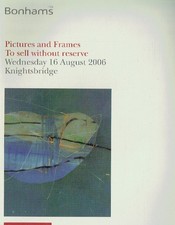 Bonhams August 2006 Pictures & Frames to Sell Without Reserve
£26.46
Bonhams August 2006 Pictures & Frames to Sell Without Reserve
£26.46
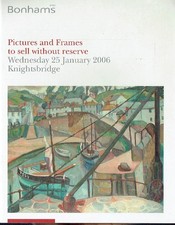 Bonhams January 2006 Pictures & Frames to Sell Without Reserve
£26.46
Bonhams January 2006 Pictures & Frames to Sell Without Reserve
£26.46
eBay listings may contain affiliate links. We may earn a commission from qualifying purchases.