Robert Riddle Jarvie (1865-1941) was an influential American designer, craftsman, and metalsmith who gained prominence during the Arts and Crafts movement in the early 20th century. Born in Glasgow, Scotland, Jarvie immigrated to the United States with his family when he was a child. He initially worked in various trades before discovering his true passion for metalwork. We take a brief look at his life and look at some of his iconic and very collectible candlesticks.
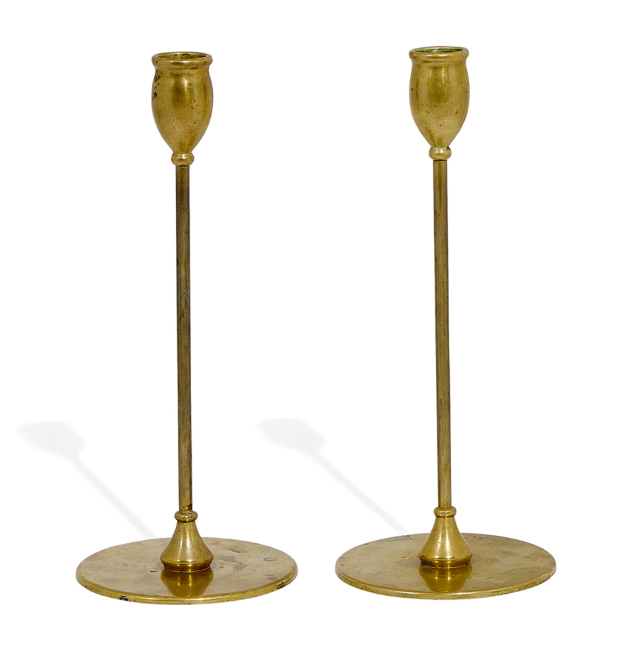
Jarvie is best known for his distinctive and innovative candlesticks, which remain some of the most sought-after examples of Arts and Crafts metalwork. His designs incorporated elements of both traditional and modern design, fusing them into a unique and harmonious aesthetic. Jarvie’s candlesticks featured clean lines, gentle curves, and a focus on functionality that was characteristic of the Arts and Crafts movement.
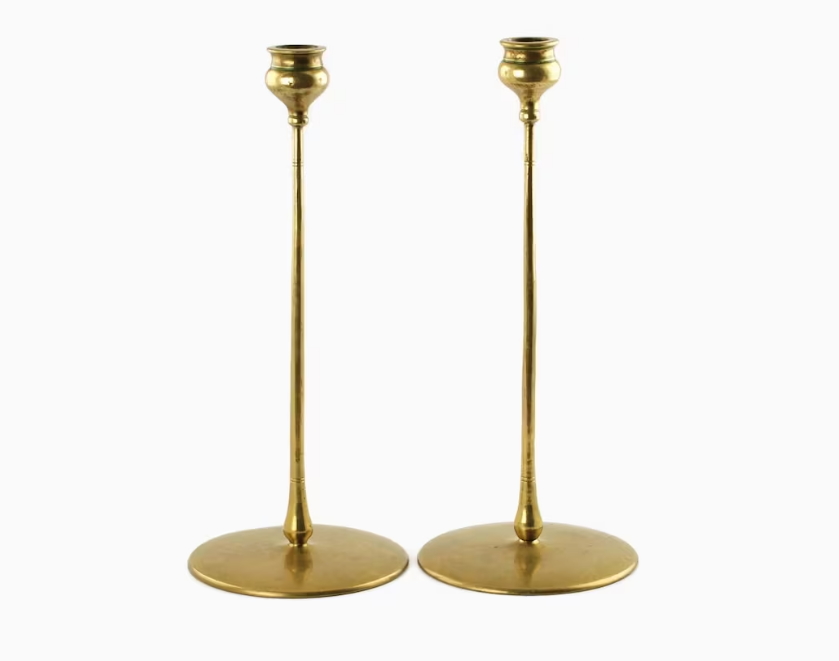
In 1904, Jarvie opened the Jarvie Shop in Chicago, where he created and showcased his metalwork, including candlesticks, bowls, and vases. The shop quickly gained a reputation for its high-quality, handcrafted items and garnered the attention of prominent patrons and collectors. The Jarvie Shop was not only a retail space but also a workshop, where Jarvie and his skilled craftsmen produced their wares.
Robert R. Jarvie, whose early advertisements label him “the Candlestick Maker,” created some of the most sophisticated metal candlesticks of the Arts and Crafts period, naming each design with a letter of the Greek alphabet.
Jarvie’s candlesticks, in particular, were a departure from the ornate, Victorian-era designs that were popular at the time. He often used materials like brass, bronze, and copper in his creations, giving them a warmth and simplicity that was characteristic of the Arts and Crafts movement. Among his most famous designs are the “Alpha” candlestick and the “Delta” candlestick.
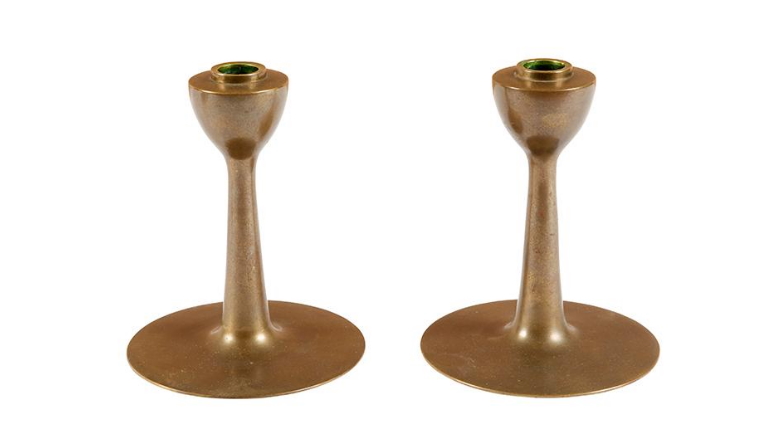
The Alpha candlestick is characterized by its round base and streamlined appearance. It features a slender, tapering stem that gracefully connects the base to the bobeche (the small dish designed to catch melted wax). The design emphasizes simplicity and balance, with an absence of ornamentation. The Delta candlestick also features a round base with a slender stem that tapers upward, but the Delta design often includes subtle, elongated curves. The bobeche is also wider, creating a visually appealing contrast between the base, stem, and top.
In addition to his work in metal, Jarvie was also known for his involvement in the wider Chicago Arts and Crafts community. He was an active member of the Chicago Arts and Crafts Society, and his work was exhibited at numerous Arts and Crafts exhibitions, both locally and nationally.
Despite the Jarvie Shop’s initial success, the business struggled in the 1920s and eventually closed in 1929. The onset of the Great Depression and the rise of mass-produced goods made it difficult for small, artisanal shops like Jarvie’s to survive. However, the legacy of Robert R. Jarvie and his candlesticks lives on, as they continue to be highly sought-after collector’s items and represent a significant chapter in the history of American decorative arts.
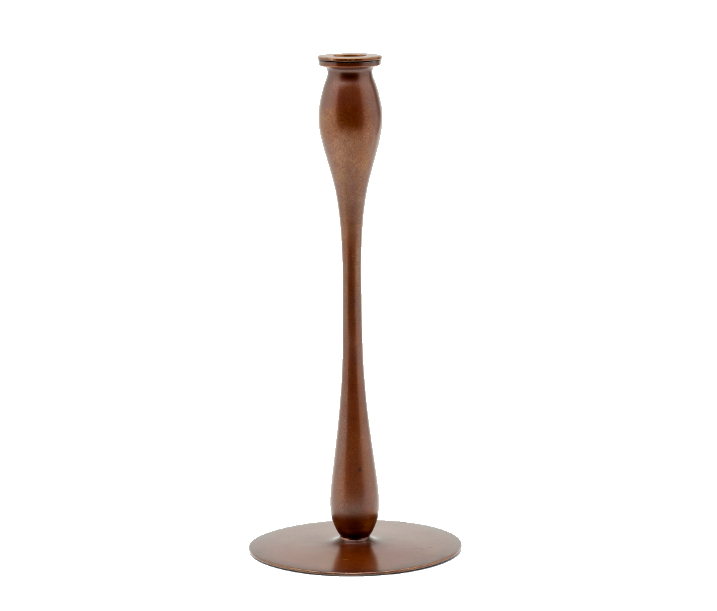
Robert Riddle Jarvie was an innovative designer and maker who made a lasting impact on the Arts and Crafts movement. He is best known for his exquisite candlesticks some of which appear in Museums such as The Met Fifth Avenue. His works are considered valuable collector’s items and serve as a testament to the enduring appeal of the Arts and Crafts aesthetic.
Related
Jarvie candlesticks on ebay
Related Collectibles on eBay
 Patinated Cast Bronze Candlesticks, 29cm/23cm - In Style Robert Jarvie Pair 2
£37.09
Patinated Cast Bronze Candlesticks, 29cm/23cm - In Style Robert Jarvie Pair 2
£37.09
 The Jarvie Shop Candlesticks & Metalwork Robert Jarvie Thomas Maher 1997 Book
£16.01
The Jarvie Shop Candlesticks & Metalwork Robert Jarvie Thomas Maher 1997 Book
£16.01
 THE JARVIE SHOP: CANDLESTICKS AND METALWORK OF ROBERT R. By Thomas K. Maher *VG*
£37.36
THE JARVIE SHOP: CANDLESTICKS AND METALWORK OF ROBERT R. By Thomas K. Maher *VG*
£37.36
 Pair Vtg Robert Jarvie Style Arts & Crafts Turned Brass Candlesticks
£162.60
Pair Vtg Robert Jarvie Style Arts & Crafts Turned Brass Candlesticks
£162.60
 Robert Riddle Jarvie Alpha Brass Candlestick Signed Underneath
£723.79
Robert Riddle Jarvie Alpha Brass Candlestick Signed Underneath
£723.79
 Robert Jarvie Style Delta Brass Candlesticks Pair-Mission Arts Crafts Brass
£249.11
Robert Jarvie Style Delta Brass Candlesticks Pair-Mission Arts Crafts Brass
£249.11
 Robert Jarvie Signed Antique Arts & Crafts Turned Brass Tall Candlesticks, Pair
£1,793.61
Robert Jarvie Signed Antique Arts & Crafts Turned Brass Tall Candlesticks, Pair
£1,793.61
 Robert Jarvie Style Antique Arts & Crafts Turned Brass Tall Candlestick
£403.56
Robert Jarvie Style Antique Arts & Crafts Turned Brass Tall Candlestick
£403.56
eBay listings may contain affiliate links. We may earn a commission from qualifying purchases.