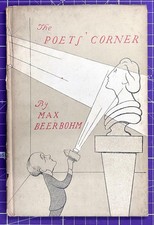
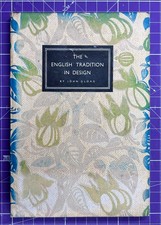
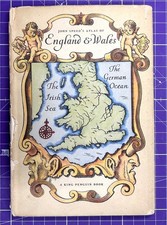
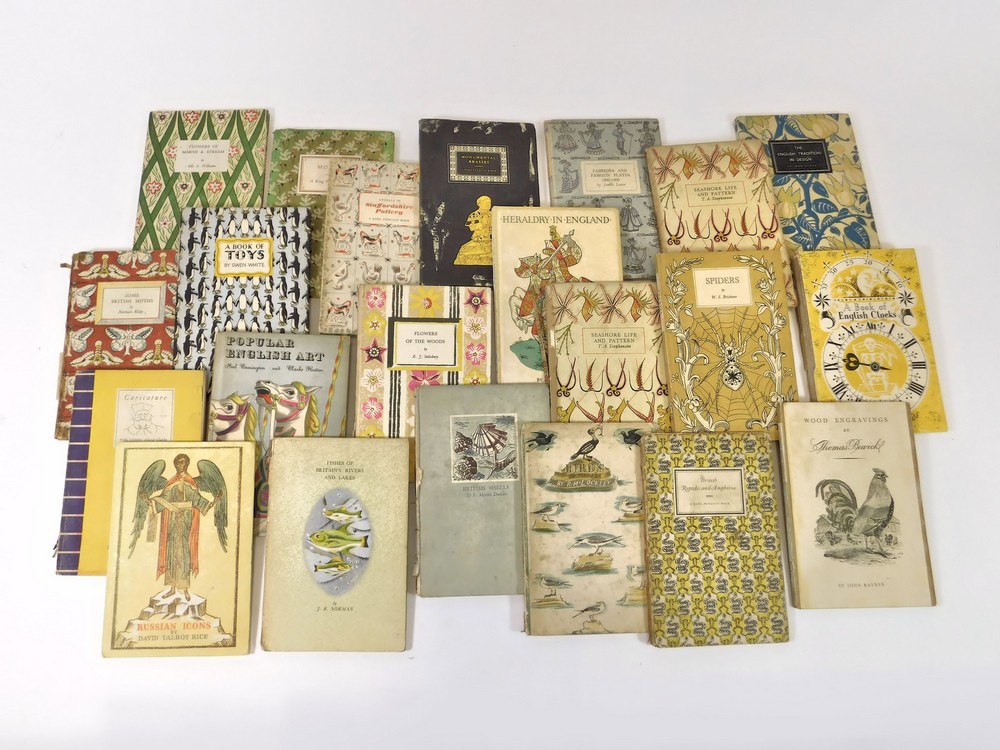
King Penguin Books are one of the most distinctive and attractive branches of Penguin collecting. Published between 1939 and 1959, the series combined compact books, specialist texts and extensive colour illustration at prices intended to make subjects normally associated with expensive illustrated books accessible to a much wider readership.
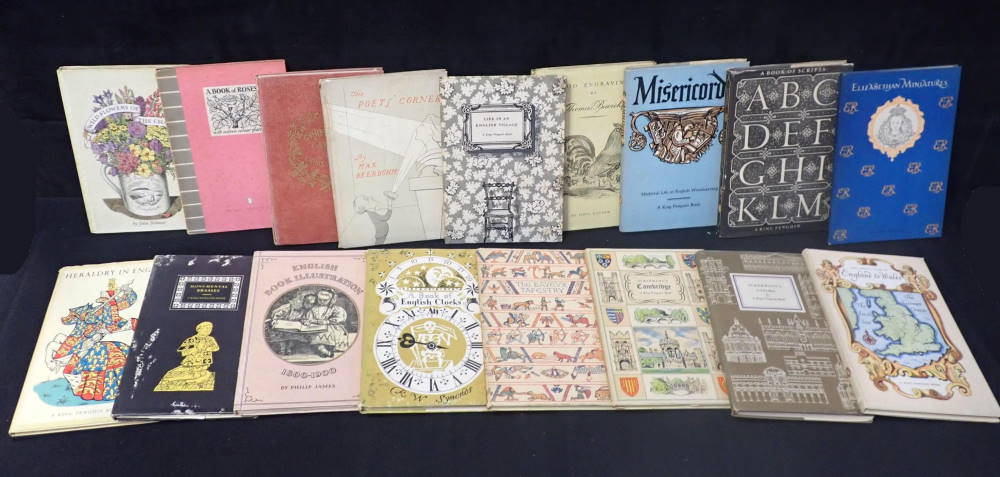
A total of 76 numbered King Penguins were published, covering an extraordinary variety of subjects. British birds, butterflies, flowers and fungi appeared alongside heraldry, fashion, clocks, railway history, Staffordshire pottery, medieval carving, cricket and the Crown Jewels.
For today’s collector, that variety is a major part of their appeal. Some people attempt to assemble the complete K1–K76 series, while others concentrate on natural history, art and design or simply collect the books whose striking covers appeal to them.
The Beginning of King Penguin Books
The first King Penguins appeared in 1939, four years after Allen Lane launched the original Penguin paperback series.
Penguin had demonstrated that good contemporary writing could be produced inexpensively for a mass readership. King Penguins extended that philosophy into illustrated publishing.
The concept drew inspiration from the small, beautifully produced illustrated books already being published in continental Europe, particularly the Insel-Bücherei series produced by Insel Verlag in Germany.
King Penguins were nevertheless given a very British identity.
Rather than the familiar horizontal bands of the early Penguin paperbacks, King Penguins generally appeared as small hardback books with decorative or pictorial covers. Inside were specialist texts accompanied by colour plates and illustrations.
The result was something that could be inexpensive yet still feel like an attractive object in its own right.
K1 – The First King Penguin
The series began with K1, British Birds on Lake, River and Stream by Phyllis Barclay-Smith, published in 1939.
Its illustrations reproduced bird paintings by the celebrated nineteenth-century ornithological artist John Gould.
Natural history would become one of the recurring themes of the series. Later King Penguins covered garden birds, moths, fungi, butterflies, beetles, reptiles, ducks, woodland birds and many other subjects.
K2, A Book of Roses by John Ramsbottom, also appeared in 1939 and used illustrations associated with the great botanical artist Pierre-Joseph Redouté.
These first two books established an important characteristic of the series: scholarly or informative text combined with carefully selected visual material.
A Remarkably Diverse Series
After the first two titles there was a gap before the series resumed during the Second World War.
K3, A Book of Ships by Charles Mitchell, appeared in 1941, followed by books including Portraits of Christ and Caricature.
During the 1940s the King Penguin list expanded rapidly.
The subjects could be remarkably specific. Readers could buy books about British shells, Elizabethan miniatures, the Bayeux Tapestry, edible fungi, heraldry, British moths, garden birds and English ballet.
Other titles explored areas of British art, architecture and design.
This eclectic approach means a collection of King Penguins is visually and intellectually varied. A natural-history book might sit beside a study of typography, an examination of military uniforms or a book devoted to an archaeological site.
Art, Illustration and Design
King Penguins are particularly interesting to collectors of twentieth-century British book design.
The series involved notable writers, artists, illustrators and designers, and the visual treatment of the books was an important part of their identity.
Edward Bawden, for example, was responsible for Life in an English Village, K51, published in 1949. Bawden’s distinctive work has given the title an appeal extending well beyond collectors of Penguin Books.
John Piper was associated with K55, Romney Marsh, while Enid Marx contributed to the design of Russian Icons.
Other volumes reproduced the work of historical artists and illustrators including Thomas Bewick, John Leech, Albrecht Dürer and John Gould.
This crossover is significant for collectors. A particular King Penguin may be wanted not simply because of its place in the K1–K76 sequence, but because somebody collects the artist, illustrator, author or subject.
Natural History King Penguins
Natural history is perhaps the most immediately recognisable collecting theme within the series.
Among the titles are books devoted to birds, flowers, fungi, shells, moths, spiders, butterflies, beetles, reptiles and amphibians.
Phyllis Barclay-Smith appeared several times during the life of the series. After writing K1, she returned with Garden Birds, A Book of Ducks and, near the end of the series, Woodland Birds.
John Ramsbottom similarly contributed books on roses and fungi.
These titles can appeal to natural-history collectors independently of their Penguin connection, particularly when their illustrations reproduce the work of important botanical or zoological artists.
Collecting King Penguin Books
With 76 numbered titles, King Penguins offer collectors something increasingly unusual: a substantial vintage book series for which completing an entire numbered run remains a realistic objective.
It is not necessarily an easy one.
The books were produced over twenty years, and availability varies considerably. Some titles appear regularly on the secondary market, while others can take much longer to locate, particularly in excellent condition.
Collectors can approach the series in several ways.
The obvious challenge is to collect K1 through K76. Alternatively, a collection might concentrate on natural history, art and design, architecture, or books associated with particular illustrators.
The decorative covers also make King Penguins attractive purely as examples of mid-twentieth-century book design.
What to Look for When Buying King Penguins
Condition matters considerably.
King Penguins were books intended to be handled and read. Covers can consequently suffer from rubbing, bumped corners, damaged spines and staining. Internally, collectors should look for missing or damaged pages and plates, inscriptions, foxing and other signs of wear.
A particularly bright, clean example can therefore be much more desirable than another copy of exactly the same title.
Collectors should also be aware of different editions and bindings. Although King Penguins are strongly associated with their small hardback format, variations exist within the series, and some titles were also produced in soft-cover forms.
It is worth checking the publication details rather than identifying a copy solely from its front cover.
Are King Penguin Books Valuable?
Most individual King Penguins are not exceptionally expensive, which is one reason the series remains attractive to collectors.
Values, however, vary according to the title, edition, condition and demand for the subject or illustrator.
Complete and near-complete collections also appear at auction.
For example, a collection of King Penguin Books sold for £50 at Duke’s Avenue Auctions in December 2023, while another group, mainly dating from the 1940s and including ten natural-history volumes, sold for £50 at Barbara Kirk Auctions in September 2023.
These results should be treated as snapshots of the market rather than fixed valuations. Auction prices can vary substantially according to the contents and condition of a lot, the venue and the level of competition between bidders.
Individual books associated with desirable artists, unusual subjects or particularly scarce editions may behave very differently from mixed groups of common titles.
For collectors, identifying exactly what is being offered is therefore much more useful than relying on a general price guide.
The Last King Penguins
The pace of publication slowed considerably during the 1950s.
Later titles included Egyptian Paintings, Misericords, John Arlott’s A Picture of Cricket, Woodland Birds and Monumental Brasses.
The series finally reached K76 with Sculpture of the Parthenon by P. E. Corbett, published in 1959.
Twenty years had passed since K1.
During that period King Penguins had created a remarkable miniature library covering natural history, art, archaeology, architecture, social history, decorative arts and numerous subjects that resist easy classification.
King Penguin Books Complete K1–K76 Checklist
The following checklist covers the complete numbered King Penguin series from K1, British Birds on Lake, River and Stream, published in 1939, to K76, Sculpture of the Parthenon, published in 1959.
The books included colour printing, illustrations or plates. Illustrators and artists are included where known.
| No. | Title | Author | Illustrator | Year |
|---|---|---|---|---|
| K1 | British Birds on Lake River and Stream | Barclay-Smith, Phyllis | John Gould | 1939 |
| K2 | Book of Roses | Ramsbottom, John | Pierre-Joseph Redouté | 1939 |
| K3 | A Book of Ships | Mitchell, Charles | Mitchell, Charles | 1941 |
| K4 | Portraits of Christ | Kitzinger, Ernst & Senior, Elizabeth | – | 1941 |
| K5 | Caricature | Gombrich, E.H & Kris, E | – | 1941 |
| K6 | British Shells | Duncan, F. Martin | – | 1943 |
| K7 | Fashions and Fashion Plates | Laver, James | – | 1943 |
| K8 | Elizabethan Miniatures | Winter, Carl | 1943 | |
| K9 | Microcosm of London | Rowlandson, T & Pugin, A C | Rowlandson & Pugin | 1943 |
| K10 | Bayeux Tapestry | MacLagen, Eric | – | 1943 |
| K11 | Fishes of Britain’s Rivers and Lakes | Norman, J.R. | – | 1943 |
| K12 | Poets’ Corner | Beerbohm, Max | – | 1943 |
| K13 | Edible Fungi | Ramsbottom, John | – | 1943 |
| K14 | Book of Lilies | Stoker, Fred | – | 1944 |
| K15 | Seashore Life and Pattern | Stephenson, T.A. | – | 1944 |
| K16 | Children as Artists | Tomlinson, R.R. | – | 1945 |
| K17 | Leaves of Southwell | Pevsner, Nikolaus | – | 1945 |
| K18 | Some British Moths | Riley, Norman | – | 1945 |
| K19 | Garden Birds | Barclay-Smith, Phyllis | – | 1945 |
| K20 | English Ballet | Leeper, Janet | – | 1944 |
| K21 | Popular Art in Britain | Carrington, Noel | – | 1945 |
| K22 | Heraldry in England | Wagner, Anthony | – | 1946 |
| K23 | Poisonous Fungi | Ramsbottom, John | – | 1945 |
| K24 | Birds of the Sea | Lockley, R.M. | – | 1945 |
| K25 | Ur: The First Phases | Woolley, Leonard | – | 1947 |
| K26 | Book of Toys | White, Gwen | – | 1946 |
| K27 | Flowers of Marsh and Stream | Williams, Iolo | – | 1946 |
| K28 | Book of English Clocks | Symonds, R.W. | – | 1947 |
| K29 | Flowers of the Woods | Salisbury, E.J. | – | 1947 |
| K30 | Wood Engravings | Bewick, Thomas | Thomas Bewick | 1947 |
| K31 | English Book Illustrations 1800-1900 | James, Philip | – | 1947 |
| K32 | A Christmas Carol | Dickens, Charles | John Leech | 1946 |
| K33 | Russian Icons | Rice, David Talbot | Cover design by Enid Marx | 1947 |
| K34 | English Tradition in Design | Gloag, John | – | 1947 |
| K35 | Book of Spiders | Bristowe, W.S. | – | 1947 |
| K36 | Ballooning | Gibbs-Smith, Charles | – | 1948 |
| K37 | Wild Flowers of the Chalk | Gilmour, John | Irene Hawkins | 1947 |
| K38 | Compliments of the Season | Ettlinger, R.D. | – | 1947 |
| K39 | Woodcuts of Albrecht Durer | Barlow, T.D. | Albrecht Durer | 1948 |
| K40 | Edward Gordon Craig | Leeper, Janet | – | 1948 |
| K41 | British Butterflies | Ford, E.B. | – | 1951 |
| K42 | British Military Uniforms | Laver, James | – | 1948 |
| K43 | Prospect of Wales | Rowntree, Kenneth | – | 1948 |
| K44 | Tulipomania | Blunt, Wilfred Jasper | – | 1950 |
| K45 | Unknown Westminster Abbey | Tanner, L.E. | – | 1948 |
| K46 | Highland Dress | Collie, George | – | 1948 |
| K47 | British Reptiles and Amphibia | Smith, Malcolm | – | 1949 |
| K48 | Book of Scripts | Fairbank, Alfred | – | 1949 |
| K49 | Some British Beetles | Taylor, Geoffrey | – | 1949 |
| K50 | Popular Art in the United States | Christensen, Erwin O. | – | 1949 |
| K51 | Life in English Village | Edward Bawden | – | 1949 |
| K52 | Isle of Wight | Jones, Barbara | – | 1950 |
| K53 | Flowers of the Meadow | Grigson, Geoffrey | – | 1950 |
| K54 | Greek Terracottas | Webster, T.B.L. | – | 1951 |
| K55 | Romney Marsh | Piper, John Egerston | – | 1950 |
| K56 | Early British Railways | Barman, Christian | – | 1950 |
| K57 | Book of Mosses | Richards, Paul | – | 1950 |
| K58 | Book of Ducks | Barclay-Smith, Phyllis | Peter Shepheard | 1951 |
| K59 | Ackermann’s Cambridge | Williamson, Reginald Ross | – | 1951 |
| K60 | Crown Jewels | Chadwick, Paxton | – | 1951 |
| K61 | Atlas of Tudor England | Speed, John | – | 1951 |
| K62 | Medieval Carvings in Exeter | Cave, C.J.P. | – | 1953 |
| K63 | Book of Greek Coins | Seltman, Charles | – | 1952 |
| K64 | Magic Books from Mexico | Burland, Cottie | – | 1953 |
| K65 | Semi-Precious Stones | Wooster, Nora | – | 1953 |
| K66 | Birds of the Plata | Hudson, W.H. | S. Magno | 1952 |
| K67 | Mountain Birds | Lodge, G.E. | – | 1952 |
| K68 | Animals in Staffordshire Pottery | Rackham, Bernard | Peggy Jeremy | 1953 |
| K69 | Ackermann’s Oxford | Colvin, H.M. | – | 1954 |
| K70 | Diverting History of John Gilpin | Cowper, William | – | 1953 |
| K71 | Egyptian Paintings | Davies, Nina | – | 1954 |
| K72 | Misericords | Anderson, M.D. | – | 1954 |
| K73 | Picture of Cricket | Arlott, John | – | 1955 |
| K74 | Woodland Birds | Barclay Smith, Phyllis | Peter Shepheard | 1955 |
| K75 | Monumental Brasses | Mann, James | – | 1957 |
| K76 | Sculpture of the Parthenon | Corbett, P.E. | – | 1959 |
Building a King Penguin Collection Today
King Penguins remain an excellent collecting field because they combine several qualities that collectors look for.
They have a clearly defined numbered series, a fascinating publishing history, attractive designs and an enormous variety of subjects. At the same time, many examples remain affordable enough for a collection to develop gradually.
A collector might begin with one appealing natural-history title or an interesting cover discovered in a second-hand bookshop and eventually find themselves searching for all 76.
That is very much in the spirit of Penguin itself.
The original Penguin revolution was about making good books accessible. King Penguins took that idea into illustrated publishing, producing small books that were informative, visually appealing and affordable.
More than eighty years after the first King Penguins appeared, those same qualities continue to make them appealing objects to collect.
Related
Collecting Penguin Books – A Collector’s Guide to Vintage Penguins
Bécherel The City of Books
Related Collectibles on eBay
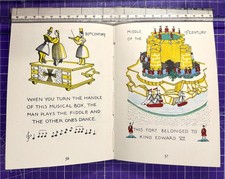 A Book of Toys, King Penguin K26, first edition
£9.73
A Book of Toys, King Penguin K26, first edition
£9.73
 King Zero
£17.42
King Zero
£17.42
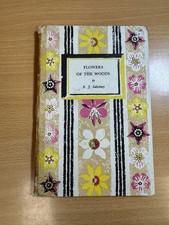 Flowers of the Woods by E. J. Salisbury 1946 Hardcover The King Penguin Books
£14.86
Flowers of the Woods by E. J. Salisbury 1946 Hardcover The King Penguin Books
£14.86
 The Book of Laughter and Forgetting (King Penguin) By Milan Kundera, M.H. Heim
£3.53
The Book of Laughter and Forgetting (King Penguin) By Milan Kundera, M.H. Heim
£3.53
 Microcosm of London, King Penguin K9, 1943 (1st Ed)
£6.52
Microcosm of London, King Penguin K9, 1943 (1st Ed)
£6.52
 A Book of Scripts, A King Penguin (K48) Rev Ed 1950
£9.73
A Book of Scripts, A King Penguin (K48) Rev Ed 1950
£9.73
 Unknown Westminster Abbey, King Penguin K45, First edition
£9.73
Unknown Westminster Abbey, King Penguin K45, First edition
£9.73
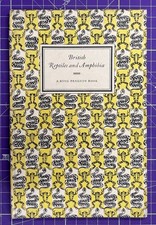 King Penguin K 47 British Reptiles and Amphibia. 1st Ed. Good to VG Condition
£12.94
King Penguin K 47 British Reptiles and Amphibia. 1st Ed. Good to VG Condition
£12.94
eBay listings may contain affiliate links. We may earn a commission from qualifying purchases.