Penguin Books transformed British publishing when the first ten titles appeared in 1935. Affordable, instantly recognisable and intended to bring good books to a much wider audience, the early Penguins cost just sixpence each – the price of a packet of cigarettes at the time.
More than ninety years later, those deceptively simple paperbacks have become a collecting field in their own right. Some collectors seek the earliest numbered Penguins, others concentrate on the familiar orange-and-white fiction titles, green Crime and Mystery books, Pelicans or Puffins. There are also numerous smaller and sometimes surprisingly scarce series, from King Penguins and Penguin Modern Painters to Puffin Cut-Out Books, Porpoise Books and Ptarmigan Books.
For the collector, this enormous variety is part of Penguin’s appeal. A collection can begin with inexpensive books found for a pound or two and gradually develop into a serious study of particular authors, cover designs, first editions, series or periods of Penguin’s history.
The Birth of Penguin Books
Penguin Books was founded by Allen Lane, then a director of the publishing house Bodley Head. The familiar story of Penguin’s creation centres on Lane returning from a visit to Agatha Christie in Devon and finding little worthwhile inexpensive reading at Exeter railway station.
Lane believed that quality contemporary literature could be successfully sold in paperback at a price affordable to almost everyone.
The first Penguin Books appeared in July 1935. There were ten titles:
- Ariel – André Maurois
- A Farewell to Arms – Ernest Hemingway
- Poet’s Pub – Eric Linklater
- Madame Claire – Susan Ertz
- The Unpleasantness at the Bellona Club – Dorothy L. Sayers
- The Mysterious Affair at Styles – Agatha Christie
- Twenty-Five – Beverley Nichols
- William – E. H. Young
- Gone to Earth – Mary Webb
- Carnival – Compton Mackenzie
Today these first ten form an obvious collecting group of their own. Early copies are considerably more desirable than the millions of later Penguins which followed, with condition, printing and individual title all affecting value.
We will be looking at these books separately in our First Ten Penguin Books Collector’s Checklist.
The Penguin Colour System
One of Penguin’s great innovations was its visual identity. Rather than illustrating each cover individually, the early books used a remarkably simple design of horizontal colour bands with the title and author prominently displayed.
The colour told the buyer what sort of book they were looking at.
Most famously, orange was used for general fiction, creating what collectors now commonly describe simply as Orange Penguins. Green identified Crime and Mystery, while dark blue was used for biographies. Other colours were introduced for different categories as the list expanded.
This makes early Penguins particularly attractive when displayed as a collection. Even somebody with little knowledge of books can immediately recognise a shelf of vintage Penguins.
For collectors, however, what initially appears to be a very simple system soon becomes considerably more complicated. Changes in typography, logos, prices, publishers’ addresses, printing statements and cover designs can all help identify different editions and printings.

Collecting Orange Penguins
The classic Orange Penguin is probably the most accessible way into collecting vintage Penguins.
Thousands of titles and editions were produced, and ordinary examples remain inexpensive. That makes it possible to build an attractive collection without spending large amounts of money.
But Orange Penguins should not be dismissed as uniformly common.
Early numbers, desirable authors, unusual editions, wartime issues, exceptionally fine copies and particular variations can be considerably harder to find. Collectors may also attempt runs by number, collect a favourite author or concentrate on Penguins from a particular period.
We will be creating a separate Collecting Orange Penguin Books reference using examples from our own collection, together with auction results to illustrate what collectors are actually paying for the more desirable books.
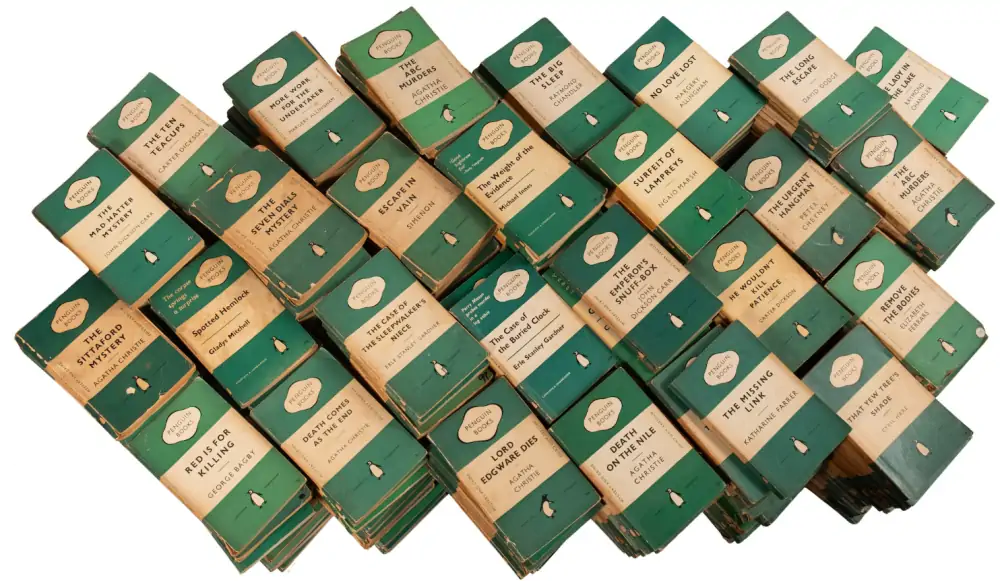
Green Penguins – Crime and Mystery
Vintage green Penguins have developed a particularly strong following.
The Crime and Mystery list included some of the great names of detective fiction, including Agatha Christie and Dorothy L. Sayers. The sixth Penguin ever published was Christie’s The Mysterious Affair at Styles, while Sayers’ The Unpleasantness at the Bellona Club was number five.
Early green Penguins can consequently appeal both to Penguin specialists and collectors of Golden Age detective fiction.
Pre-war and wartime copies, scarce titles and books in unusually good condition deserve particular attention.
Pelican Books
Penguin quickly expanded beyond fiction. Launched in 1937, Pelican Books brought serious non-fiction to the mass paperback market.
The distinctive blue Pelicans covered an extraordinary range of subjects, including history, politics, economics, science, art, architecture and social affairs.
As with ordinary Penguins, the majority remain inexpensive. Nevertheless, early books, unusual subjects, important authors and particular editions can be collectible.
The series also demonstrates why collecting Penguins can become so absorbing: what starts as an interest in orange paperbacks can quickly develop into an exploration of an entire family of related books and imprints.
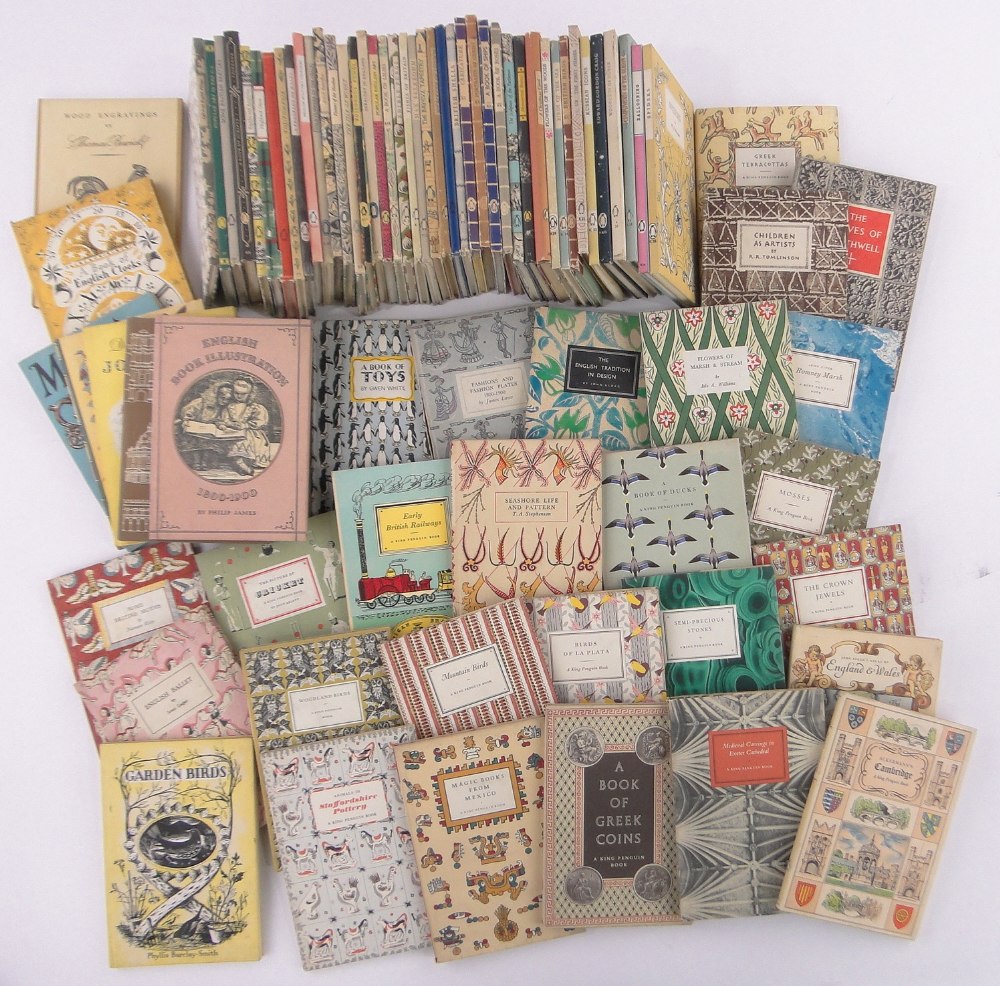
King Penguin Books
King Penguins are quite different.
Introduced in 1939, these small illustrated books combined scholarly texts with colour plates and attractive pictorial boards. Their inspiration came partly from the illustrated books produced by the German publisher Insel Verlag.
Subjects ranged from British birds, flowers and architectural ornament to porcelain, heraldry and works of art.
Unlike ordinary Penguins, King Penguins were objects designed to be attractive in themselves. Their illustrations and bindings have consequently given them an audience extending beyond Penguin collectors to people interested in design, natural history, art and particular specialist subjects.
A complete run comprises 76 King Penguin titles, making this one of the more achievable Penguin series to collect systematically.
Our King Penguin Books Checklist and History provides a complete K1–K76 listing, including titles, authors, publication dates and illustrators where known. The guide also looks at collecting the series and examples of King Penguins sold at auction.
Puffin Books and Children’s Penguins
Penguin’s children’s publishing created another enormous collecting field.
Puffin Picture Books began during the Second World War, followed by Puffin Story Books and numerous other formats. Artists, illustrators and designers played an especially important role in establishing Puffin’s distinctive appearance.
Some of the more unusual children’s publications are now among the fascinating sidelines of Penguin collecting.
These include Baby Puffin and the ingenious Puffin Cut-Out Books. The latter were designed to be cut up and assembled, meaning that complete surviving copies inevitably became difficult to find.
That illustrates an important principle of book collecting: books originally intended to be used, altered or discarded can become considerably scarcer than books deliberately preserved.
Penguin Modern Painters
Another highly collectable short series is Penguin Modern Painters, published between the 1940s and 1950s.
The series concentrated on important contemporary artists and combined critical essays with reproductions of their work.
Subjects included Henry Moore, Graham Sutherland, Duncan Grant, Paul Nash, John Piper, Edward Bawden, Stanley Spencer, Ben Shahn, Paul Klee, Edward Hopper and Georges Braque.
There were only 19 published numbered volumes – there was no number 18 – making a complete collection an interesting and realistic objective.
We will publish a separate Penguin Modern Painters Complete Checklist, including the authors of the individual studies and publication details.
Other Penguin Series to Collect
Once one moves beyond the best-known Penguins, there is an extraordinary variety of material.
Penguin New Writing combined the inexpensive Penguin format with a literary journal. Peacock Books attempted to bridge the gap between children’s and adult reading, while Peregrine Books were aimed at a more academic readership.
There were also much shorter experiments.
Ptarmigan Books, for example, offered children’s game, puzzle and quiz books during the 1940s. Porpoise was an extremely short-lived venture into illustrated children’s hardbacks. Other Penguin projects appeared briefly and disappeared, sometimes leaving collectors with only a handful of titles to find.
These smaller series can provide particularly satisfying collecting projects because completing them is theoretically possible – although finding the final elusive title may prove another matter entirely.
What Makes a Penguin Book Collectable?
Age alone does not make a Penguin valuable. Millions of Penguins survive and many later examples have little monetary value.
Collectors should instead look at a combination of date, series number, printing, author, scarcity, condition and edition.
Condition is particularly important with early paperbacks. Penguins were inexpensive working books rather than luxury objects. They were carried in pockets and bags, read repeatedly, lent to friends and eventually discarded.
Finding an eighty- or ninety-year-old paperback with a clean, bright cover and an undamaged spine can therefore be much harder than simply finding the title.
Early low-numbered Penguins naturally attract attention, as do early Crime and Mystery titles. Wartime and Forces editions, unusual overseas printings, early children’s books and some specialist art and design series provide further areas for research.
Perhaps most importantly, never assume that an apparently ordinary old Penguin is either valuable or worthless solely because of its age. Identifying the exact edition is part of the enjoyment.
Building a Penguin Collection Today
One of the pleasures of collecting Penguins is that it remains possible to make discoveries.
Common vintage Penguins still appear in charity shops, second-hand bookshops, book fairs, mixed boxes at auction and online. A collector can therefore begin very cheaply.
Rather than buying indiscriminately, however, it can be more rewarding to develop a theme.
You might collect the earliest numbered Penguins, Orange Penguins, green Crime titles, a favourite author, King Penguins, Puffins or one of the smaller specialist series. Others collect books for their cover design, typography or Penguin logos.
And there is no reason for a collection to remain static. Researching the books, identifying different printings and replacing worn copies with better examples can be as satisfying as adding new titles.
Penguin Books – An Expanding Collector’s Reference
This guide is the starting point for a new World Collectors Net reference devoted to collecting Penguin Books.
Over time we will be adding illustrated checklists and specialist guides covering Orange Penguins, the first ten Penguin Books, King Penguins, Puffins, Penguin Modern Painters and some of Penguin’s lesser-known series.
Where appropriate, these guides will also include actual auction results and market observations, rather than relying upon historic price guides. Values inevitably change, but recorded sales can help show which books collectors are actively seeking and how much factors such as condition and edition can matter.
We will also be illustrating the reference with books from our own collection. That seems particularly appropriate for Penguin. These books were created to be bought, read and enjoyed – and more than ninety years after the first ten appeared, collectors are still doing exactly that.
Related
King Penguin Books Checklist and History
Related Collectibles on eBay
 A Murder Most Unladylike By Robin Stevens 11 Books Set - Ages 9+ - Paperback
£23.99
A Murder Most Unladylike By Robin Stevens 11 Books Set - Ages 9+ - Paperback
£23.99
 Vintage Penguin Books Classified List Bundle - 1952, Spring 1953, 1956 & 1957
£41.78
Vintage Penguin Books Classified List Bundle - 1952, Spring 1953, 1956 & 1957
£41.78
 4 Vintage Penguin Books From 1952 And Later
£9.99
4 Vintage Penguin Books From 1952 And Later
£9.99
 Penguin Clothbound Classics 4 Book Collection Set - NEW (Free P+P) Jane Austen
£29.99
Penguin Clothbound Classics 4 Book Collection Set - NEW (Free P+P) Jane Austen
£29.99
 Switzy
£11.97
Switzy
£11.97
 1950's KING PENGUIN BOOKS Choose Drop Down Box Illustrated
£8.00
1950's KING PENGUIN BOOKS Choose Drop Down Box Illustrated
£8.00
 PENGUIN BOOKS display Beena Studio
£19.00
PENGUIN BOOKS display Beena Studio
£19.00
 Cold Sunset
£12.37
Cold Sunset
£12.37
eBay listings may contain affiliate links. We may earn a commission from qualifying purchases.