One of the finest portraits of Britain’s greatest military hero has returned to the market after almost ninety years. Christie’s is offering Sir Thomas Lawrence’s magnificent Portrait of Arthur Wellesley, 1st Duke of Wellington as the centrepiece of its Old Masters Evening Sale during Classic Week in London, with an estimate of £8–12 million. The portrait is regarded as one of the most important works by Lawrence to appear at auction in recent decades.
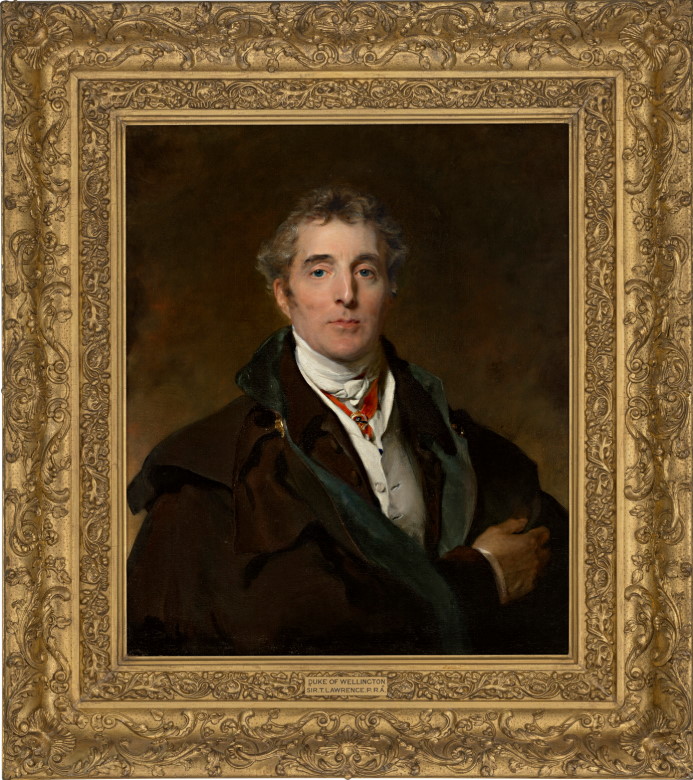
Painted in 1820, just five years after Wellington’s victory over Napoleon at the Battle of Waterloo, the portrait captures the Duke at the height of his fame. Rather than depicting him in full military uniform, Lawrence presents Wellington in civilian dress, draped in a military cloak and wearing only the insignia of the Order of the Golden Fleece. The restrained composition shifts the emphasis away from military triumph and instead reveals the character and quiet authority of the man himself.
The commission came from Charles and Harriet Arbuthnot, close friends of the Duke. Charles Arbuthnot was a distinguished diplomat and politician, while Harriet became one of Wellington’s closest confidantes. Their friendship with the Duke is well documented through correspondence and journals, making this portrait as much a record of personal affection as an official state likeness. The painting was exhibited to great acclaim at the Royal Academy in 1822, the same period in which Lawrence had become President of the Royal Academy.
Lawrence painted Wellington on several occasions, but this particular version occupied a special place in the Duke’s own estimation. Wellington is reported to have described it as “one of the best if not the best” portrait Lawrence ever painted of him. It was also this likeness that Wellington selected for reproduction as a mezzotint by Samuel Cousins, ensuring that it became the image through which much of Victorian Britain came to recognise its national hero.
The portrait has remained in distinguished private collections throughout its history. After passing through the Arbuthnot family, it was sold at Christie’s in 1878, when it was acquired on behalf of Archibald Primrose, 5th Earl of Rosebery. It later descended to the 6th Earl of Rosebery before returning to Christie’s in 1939, where it was purchased by W.U. Goodbody. The painting has remained in the Goodbody family ever since, making its appearance at auction a rare event for collectors and institutions alike.
Art historians have often compared Lawrence’s portraits of Wellington with other defining images in British history, such as Hans Holbein’s portraits of Henry VIII or Gilbert Stuart’s depictions of George Washington. Each artist succeeded in creating an image that came to define not only the sitter but also an entire era. Lawrence’s sensitive handling of light, rich colour and psychological insight transformed Wellington from victorious general into one of the great statesmen of the nineteenth century.
The painting itself is relatively intimate in scale, measuring 76.2 × 64.8 cm (30 × 25½ inches), yet its impact is monumental. Lawrence’s subtle modelling of Wellington’s features and his masterly treatment of the dark cloak create an image of quiet confidence rather than theatrical grandeur. It is this balance of dignity and humanity that has made the portrait one of the artist’s greatest achievements.
With an estimate of £8–12 million, the portrait headlines Christie’s Old Masters Evening Sale and offers collectors a rare opportunity to acquire a work that combines exceptional artistic quality, impeccable provenance and profound historical importance. More than two centuries after it was painted, Lawrence’s portrait remains one of the defining images of the Duke of Wellington and one of the masterpieces of British portraiture.
For more details visit Christies.com
Related Collectibles on eBay
 Striking Large George IV Prince Regent Oleograph Print After Sir Thomas Lawrence
£234.70
Striking Large George IV Prince Regent Oleograph Print After Sir Thomas Lawrence
£234.70
 Framed Print of LADY GEORGIANA FANE by SIR THOMAS LAWRENCE 54cm x 40 cm. GC.
£14.99
Framed Print of LADY GEORGIANA FANE by SIR THOMAS LAWRENCE 54cm x 40 cm. GC.
£14.99
 Antique Framed Etching Lady by Ellen Joweth Grosvenor after Sir Thomas Lawrence
£31.90
Antique Framed Etching Lady by Ellen Joweth Grosvenor after Sir Thomas Lawrence
£31.90
 The Red Boy Sir Thomas Lawrence Charles Lampton Copy Reproduction Oil Painting
£43.00
The Red Boy Sir Thomas Lawrence Charles Lampton Copy Reproduction Oil Painting
£43.00
 Old Board-Mounted Print-Sir Thomas Lawrence Style Child Portrait, Canvas Effect
£15.07
Old Board-Mounted Print-Sir Thomas Lawrence Style Child Portrait, Canvas Effect
£15.07
 Vintage Pinkie Print Sir Thomas Lawrence Miniature Gold Brass Frame 6x4.5"
£29.99
Vintage Pinkie Print Sir Thomas Lawrence Miniature Gold Brass Frame 6x4.5"
£29.99
 MISS MURRAY , Sir Thomas Lawrence Reproduction Oil On Canvas
£146.30
MISS MURRAY , Sir Thomas Lawrence Reproduction Oil On Canvas
£146.30
 Sir Thomas Lawrence (1769-1830) Oil Painting On Board Copy By H E Mitchell 1965
£55.25
Sir Thomas Lawrence (1769-1830) Oil Painting On Board Copy By H E Mitchell 1965
£55.25
eBay listings may contain affiliate links. We may earn a commission from qualifying purchases.