Enamelled coins are an unusual meeting point between numismatics, jewellery and the decorative arts. Victorian craftsmen took genuine coins, engraved or altered their surfaces and added brightly coloured enamels, transforming everyday currency into brooches, pendants and miniature works of art.
Although coins had been incorporated into jewellery for centuries, the fashion for enamelling British coins became particularly popular during the 1880s. Queen Victoria’s Golden Jubilee in 1887 proved especially important. The celebrations created enormous demand for Royal souvenirs and commemorative jewellery, while the new Jubilee coinage provided enamellers with ideal subjects.
Crowns, halfcrowns, florins, double florins, shillings and sixpences can all be encountered with enamel decoration, together with much scarcer examples made from gold sovereigns.
How Enamelled Coins Were Made
 The majority of Victorian enamelled coins retained at least part of the original design of the host coin.
The craftsman could cut away or engrave areas of the background while leaving lettering, portraits, shields and other features standing. In more elaborate examples parts of the original design might be substantially altered or removed.
Enamel was then applied to selected areas and fired. Different colours and effects could require several stages of enamelling, firing, grinding and finishing. Engraving beneath translucent enamel could also be used to manipulate the way light passed through the colour, producing considerably more subtle effects than simply painting the surface of a coin.
The results range from relatively simple pieces using only a few colours to remarkably elaborate compositions filled with translucent enamels and minute engraved detail.
Flowers and foliage, coats of arms, flags, Britannia, St George and the Dragon and portraits of Queen Victoria were popular subjects. The heraldic reverse of the 1887 halfcrown and double florin was particularly well suited to colourful enamel decoration.
Many pieces were mounted as brooches or pendants and were intended from the outset to be worn as jewellery rather than retained as coins.
William Henry Probert and the Steel Family
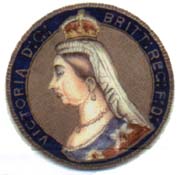
Two names are particularly associated with the finest British enamelled coins: William Henry Probert and the Steel family of Birmingham.
Probert is traditionally credited with producing some of the earliest Victorian examples in his Birmingham workshop. His earlier pieces tended to employ a relatively restrained palette, sometimes using no more than three colours, but were distinguished by accomplished engraving. As demand for enamelled coin jewellery developed, the designs became increasingly colourful and elaborate.
The Steel family became another important name in the trade.
Edwin Steel established a Birmingham business specialising in enamelled coin jewellery during the 1880s. Pieces associated with the Steels are often among the most accomplished examples encountered by collectors. Particularly effective work combined engraving beneath translucent enamel with carefully chosen colours, allowing reflected light to give the finished decoration considerable depth.
The business continued through succeeding generations of the family, and enamelled coins remained fashionable into the early years of the 20th century.
Attribution, however, needs some caution. Many surviving pieces are unsigned and similarities in technique do not by themselves prove that an individual coin was produced by Probert, Steel or another particular workshop.
The Importance of 1887
Queen Victoria’s Golden Jubilee made 1887 an exceptional year for commemorative objects of almost every description.
It was also the year that the Jubilee Head coinage appeared, including new designs by Joseph Edgar Boehm. These coins coincided perfectly with the fashion for enamelled jewellery.
As a result, collectors today encounter a disproportionate number of enamelled coins dated 1887. Crowns and double florins offered relatively large surfaces on which enamellers could work, while smaller denominations could readily be converted into brooches and pendants.
Not every enamelled coin dated 1887 was necessarily decorated during the Jubilee year itself. Coins could be altered later, so the date of the host coin should not automatically be treated as the date when the enamelling was carried out.
Single and Double-Sided Enamelled Coins
Most antique examples have enamel decoration on one face only. Occasionally, however, coins are encountered with both sides enamelled.
Our original World Collectors Net article, published in 1999, raised an interesting question about the practical difficulty of firing enamel on the second face without damaging the work already completed on the first.
Double-sided enamelling was certainly achieved, but the precise working methods could vary. Rather than assuming that the techniques used by individual Victorian workshops have been completely documented, these pieces are best regarded as evidence of the considerable technical skill available to specialist enamellers.
Double-sided antique examples are particularly interesting to collectors, especially where both faces incorporate detailed engraving and translucent enamel.
Gold Enamelled Coins
Among the most desirable examples are enamelled gold coins.
Sovereigns and other gold coins were intrinsically valuable even when they were current currency, making their deliberate conversion into decorative jewellery considerably more extravagant than altering a silver coin.
Surviving Victorian gold examples are consequently much less commonly encountered than enamelled silver coins. They can combine several collecting interests: numismatics, antique jewellery, enamelling and Royal memorabilia.
Collectors should nevertheless distinguish genuine period pieces from coins enamelled much later. The practice of adding coloured decoration to coins did not disappear permanently, and modern enamelled coins are also encountered.
Collecting Enamelled Coins Today
For collectors, quality of workmanship can be more significant than simply the denomination or date of the underlying coin.
Look closely at the engraving, the complexity and translucency of the enamel and the way in which the craftsman has incorporated the original coin design into the finished composition. Finely worked Victorian pieces can be very different objects from later coins with relatively simple surface decoration.
Condition is also important. Enamel is glass and can chip, crack or become detached, particularly around the edges of a coin. Jewellery mounts should be examined for damage and repair, although an original brooch or pendant fitting is part of the history of an object intended to be worn.
Attribution should be treated carefully unless a piece is signed, documented or displays convincing characteristics associated with a known maker.
Enamelled coins occupy a fascinating niche. To the strict numismatist they are altered coins; to the jewellery collector they are miniature Victorian ornaments. At their best, however, they demonstrate extraordinary ingenuity – taking the familiar designs of Britain’s circulating coinage and turning them into colourful objects that could be worn and admired.
More than a century later, the best examples remain miniature demonstrations of the engraver’s and enameller’s art.
Related Collectibles on eBay
 Hexagon Bee Novelty Coin Medallion with Colour Enamel in Clear Capsule
£10.80
Hexagon Bee Novelty Coin Medallion with Colour Enamel in Clear Capsule
£10.80
 1932 George V Farthing Coin Pendant Enamelled Round, inc mount
£12.00
1932 George V Farthing Coin Pendant Enamelled Round, inc mount
£12.00
 BEAUTIFULLY ENAMELLED ANTIQUE SILVER COINS GEORGE III-VICTORIA PICK ACTUAL ONE
£34.99
BEAUTIFULLY ENAMELLED ANTIQUE SILVER COINS GEORGE III-VICTORIA PICK ACTUAL ONE
£34.99
 a309 An 1825 George VI Enamelled Silver Shilling
£25.00
a309 An 1825 George VI Enamelled Silver Shilling
£25.00
 RARE! Komsko Twin Fangs Blades 2oz Silver Swords Coins .999
£298.34
RARE! Komsko Twin Fangs Blades 2oz Silver Swords Coins .999
£298.34
 RMS TITANIC Silver Commemorative Coin. Colour/Enamel. White Star Liner. 1912
£9.99
RMS TITANIC Silver Commemorative Coin. Colour/Enamel. White Star Liner. 1912
£9.99
 925 Fine Silver Enamel Coin Pendant Round Reversible Royalty Design 1921
£29.82
925 Fine Silver Enamel Coin Pendant Round Reversible Royalty Design 1921
£29.82
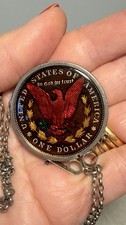 Vintage Enamelled 1921 Morgan Dollar Coin Pendant Silver Mount & Chain
£48.00
Vintage Enamelled 1921 Morgan Dollar Coin Pendant Silver Mount & Chain
£48.00
eBay listings may contain affiliate links. We may earn a commission from qualifying purchases.