Today it is almost expected that a major fashion house will have its own perfume. Chanel, Dior, Givenchy, Yves Saint Laurent and numerous other names have made fragrance an integral part of their identity. In the early years of the 20th century, however, the idea was revolutionary.
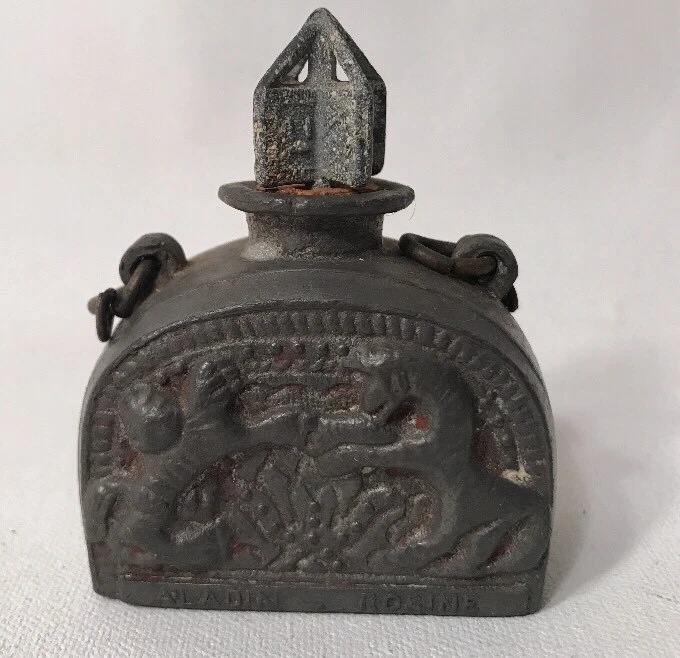
One of the pioneers was the flamboyant Paris couturier Paul Poiret, who in 1911 established his own perfume house, Les Parfums de Rosine. Named after his eldest daughter, Rosine, the company brought together fragrance, fashion, bottle design, illustration and decorative art in a way that anticipated the modern designer perfume industry.
For collectors today, surviving Rosine perfume bottles and presentations are fascinating objects in their own right. Often imaginative and sometimes extraordinarily elaborate, they provide a direct link with one of the most creative figures in early 20th-century fashion.
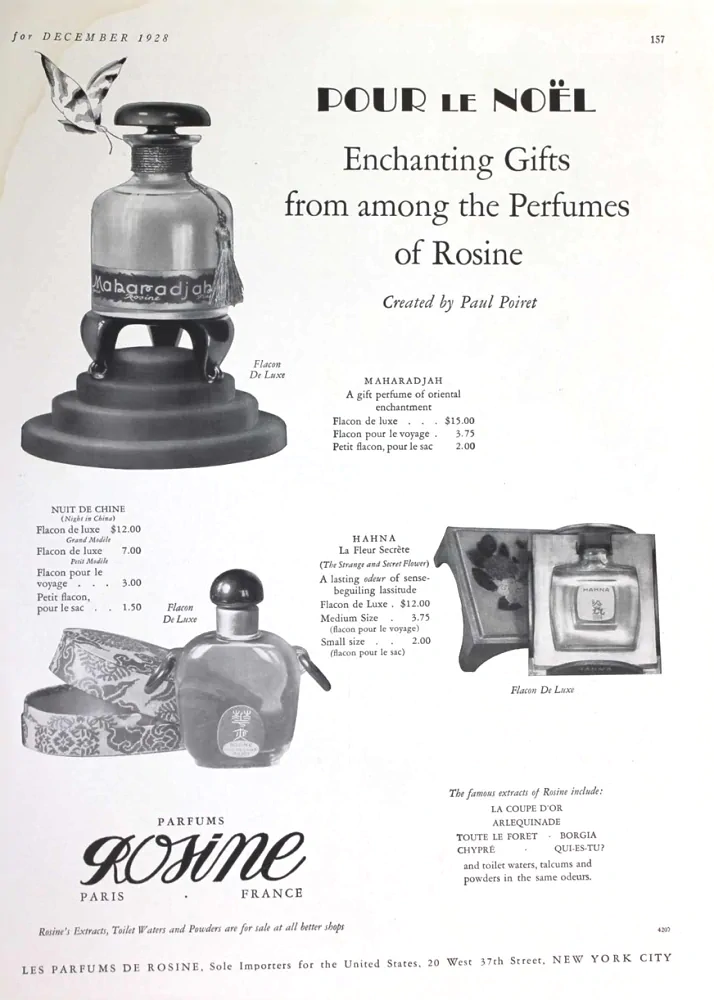
Paul Poiret – Fashion Designer and Perfumer
Born in Paris in 1879, Paul Poiret worked for the celebrated couturiers Jacques Doucet and the House of Worth before establishing his own fashion house in 1903. He became one of the most influential designers of the period, helping move women’s fashion away from the heavily corseted silhouette of the late Victorian and Edwardian eras towards looser and more fluid forms.
Poiret was also an exceptional promoter. Fashion, theatre, parties, illustration, interior decoration and perfume all became part of the world he created around his name.
In 1911 he expanded his business in two particularly important directions. Les Parfums de Rosine, named after his eldest daughter, produced perfumes and cosmetics, while Martine, named after his second daughter, was devoted to interiors and the decorative arts.
The Metropolitan Museum of Art considers this development especially significant, observing that through Rosine and Martine Poiret “effectively invented the modern concept of ‘lifestyle marketing.’”
It is an idea that seems remarkably modern. Rather than simply selling dresses, Poiret was creating an entire world in which a customer could wear his clothes, use his perfume and surround herself with furnishings and decorative objects reflecting the same artistic vision.
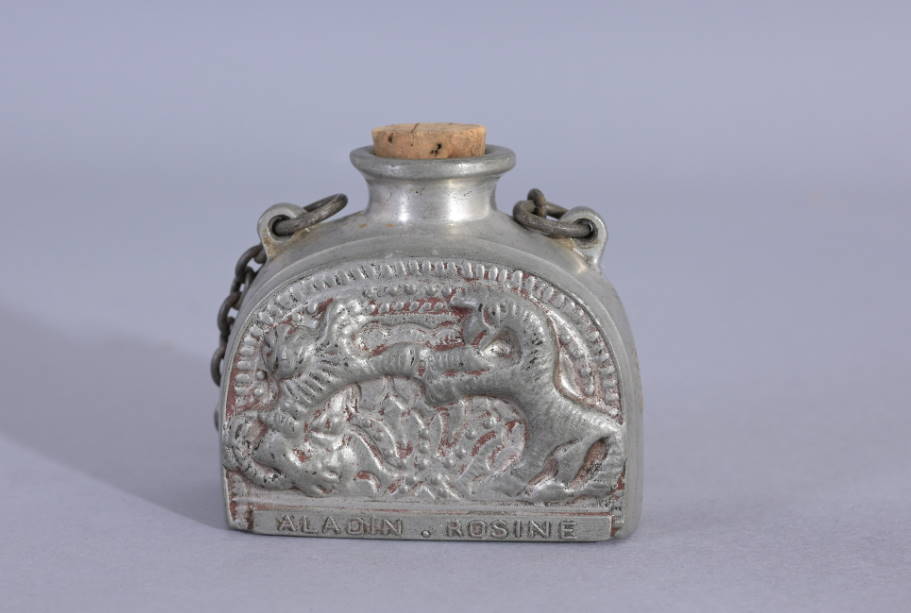
Les Parfums de Rosine
Poiret’s perfume company was unusual in another important respect. Rather than simply licensing his name to an established perfume manufacturer, he took a close interest in the fragrances and their presentation.
He worked with perfumers including Henri Alméras, who would later become famous as the creator of Jean Patou’s Joy, as well as other specialist perfumers. Over its lifetime Les Parfums de Rosine produced around forty fragrances, although sources differ on the exact total.
The range extended far beyond perfume itself. Eau de toilette, scented soaps, face powders, lotions, creams, talcum powder, nail products and other cosmetics allowed Poiret to develop Rosine into a complete beauty brand.
Yet it is the extraordinary attention paid to packaging that makes Rosine particularly interesting to today’s collectors.
Perfume Bottles as Works of Art
For Poiret, the bottle, label and box were part of the perfume rather than merely containers for it. From the beginning, the presentation of Les Parfums de Rosine was closely connected with the other artistic enterprises surrounding his fashion house.
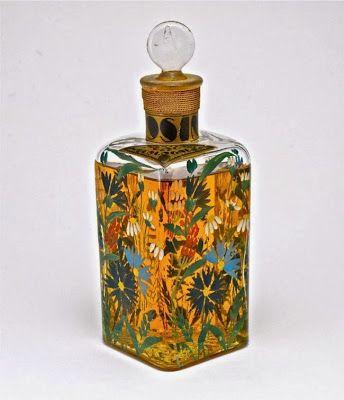
Some of the earliest Rosine perfume bottles of the early 1910s were individually hand-painted through Atelier Martine, the decorative arts enterprise Poiret had named after his second daughter. The associated École Martine trained young women in decorative arts, including drawing, weaving and the decoration of ceramics and glass. Their designs were developed by Atelier Martine, and some of the young artists also helped create bottles and packaging for Les Parfums de Rosine.
This connection between the two businesses is particularly important for collectors. An early Rosine bottle was not simply a container commissioned from a glass manufacturer: some examples were individually decorated objects produced as part of the same artistic world as Poiret’s fashions, textiles and interiors.
Poiret also collaborated with some of the most important illustrators and decorative artists of his time, including Paul Iribe, Georges Lepape and Raoul Dufy. Designs associated with his Martine studios were incorporated into perfume packaging and promotional material.
The result was an extraordinary variety of bottles. Unlike companies that established a standard bottle and used it for many fragrances, Rosine presentations could be designed specifically to complement the name and character of an individual scent.
Decorative boxes incorporated colourful papers, textiles, tassels and other materials, while Poiret even established a separate packaging workshop, Ateliers Colin, named after another of his children. Perfume, bottle, label, box and ornamentation were conceived together as part of the complete presentation.
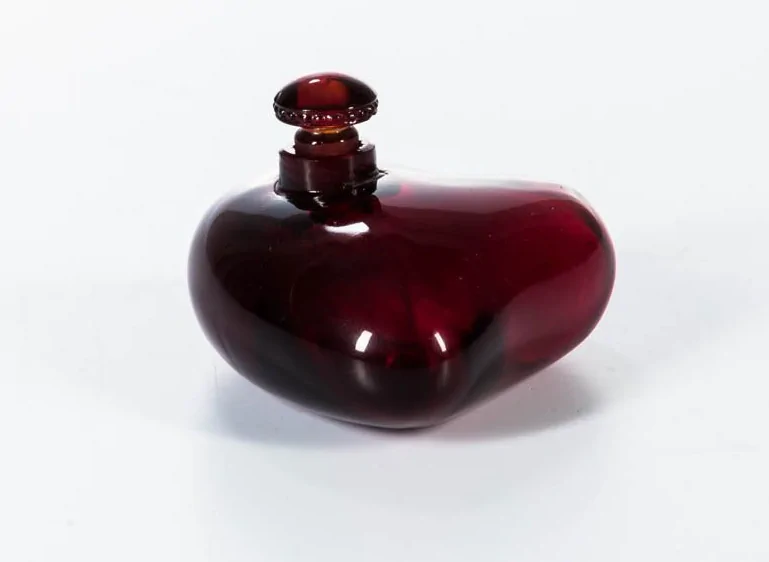
La Rose de Rosine
Among the earliest and most interesting Rosine presentations is La Rose de Rosine, dating from 1912 and designed by Paul Poiret with Paul Iribe. The rose had particular significance for Poiret and appeared as an emblem on his fashion label. The perfume’s presentation developed the motif further.
The bottle itself is particularly ingenious. According to material published by the Musée International de la Parfumerie in Grasse, its form was inspired by the extraordinary wide-skirted dress worn by the young Infanta Margarita in Diego Velázquez’s famous 1656 painting Las Meninas. The presentation demonstrates perfectly why Rosine bottles appeal not only to perfume collectors but also to collectors of fashion and early 20th-century design.
Nuit de Chine and the Early Use of Bakelite
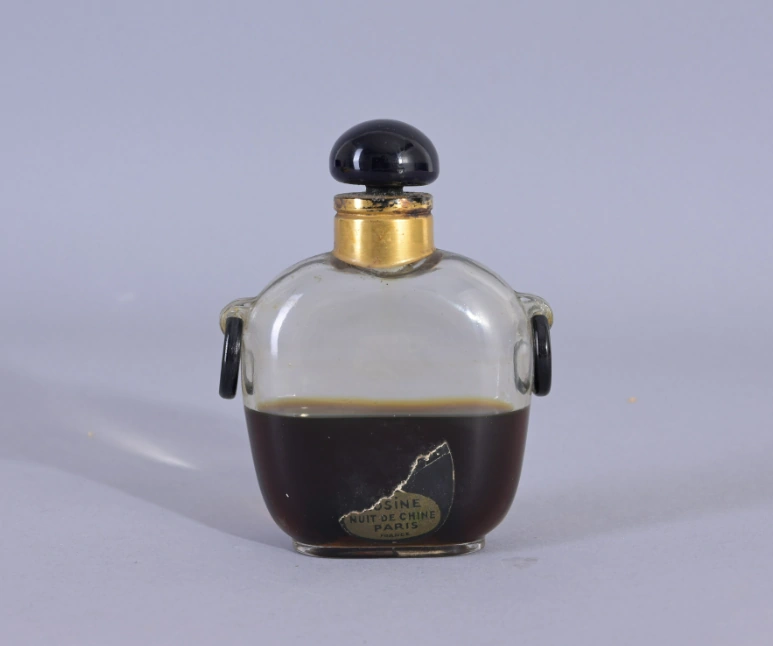
Another important Rosine perfume is Nuit de Chine, introduced in 1913.
Its distinctive presentation was designed by Georges Lepape, while the fragrance was created by perfumer Maurice Schaller. The bottle is especially interesting to collectors because its design incorporated Bakelite side rings, an unusually early use of the material in luxury perfume packaging.
The Musée International de la Parfumerie describes Nuit de Chine as the first perfume bottle to use Bakelite for these side rings and records it as one of the greatest commercial successes of Les Parfums de Rosine.
The Chinese characters appearing on the label further enhanced the exotic character of the presentation, reflecting Poiret’s fascination with the artistic interpretations of Asia and the Middle East fashionable in Paris during the period.
Other Rosine Perfumes
The variety of names used by Les Parfums de Rosine gives some indication of the imaginative world Poiret created around his fragrances.
Among the perfumes collectors may encounter are Chez Poiret, Arlequinade, Borgia, Aladin, Le Balcon, Fruit Défendu, Maharadjah, Coupe d’Or, Sa Chambre and Avenue du Bois, as well as La Rose de Rosine and Nuit de Chine.
Avenue du Bois, for example, dates from the later period of the company and is known in a distinctive bottle with a large ribbed spherical stopper. The variety between such designs is one reason that assembling a representative Rosine collection can be challenging.
Collecting Les Parfums de Rosine
Original Rosine bottles are considerably less commonly encountered than the mass-produced perfume bottles of companies such as Bourjois, making the subject particularly interesting for specialist collectors.
Collectors should look beyond the glass bottle itself. Original labels, stoppers, boxes, tassels and decorative packaging can be integral parts of the original design and considerably enhance both the historical interest and desirability of an example.
Condition must also be considered carefully. These objects are now around a century old and many incorporate materials more vulnerable than glass. Paper labels become stained or detached, decorative cords and tassels disappear, boxes become damaged and hand-painted decoration can wear.
Conversely, a Rosine bottle retaining its original presentation can provide an unusually complete example of early 20th-century commercial design.
Identification can sometimes be difficult. With so many different fragrances and presentations produced, an unfamiliar bottle may not immediately be recognised as Rosine. Old catalogues, specialist perfume references, museum collections and documented auction examples therefore become particularly valuable to collectors.
The Legacy of Paul Poiret and Rosine
Poiret’s influence extended far beyond the individual perfumes produced by Rosine.
When Chanel No. 5 appeared in 1921, the relationship between fashion designer and fragrance that now seems completely natural was still relatively new. Poiret had begun developing the idea a decade earlier.
As The Metropolitan Museum of Art has noted, he established an important blueprint for the modern fashion business by linking fashion with perfume, cosmetics and decorative arts. His Rosine fragrances were not simply products carrying a fashionable name; their bottles, boxes, labels and advertising were conceived as parts of a broader artistic identity.
That is perhaps why Les Parfums de Rosine remains such an intriguing collecting subject. A surviving bottle can simultaneously be an example of perfume history, packaging design, fashion history and decorative art.
More than a century after Rosine was founded, the idea pioneered by Poiret has become an ordinary part of the fashion industry. Almost every great couture name has subsequently entered the perfume market. The remarkable bottles of Les Parfums de Rosine survive from a time when that relationship between fashion and fragrance was only just beginning.
Sources & Further Reading
Soraya Feder, Divine Beauty: The Art of Collectibles – illustrated reference material on Paul Poiret and Les Parfums de Rosine, including examples from the author’s collection.
The Metropolitan Museum of Art – research and exhibition material relating to Paul Poiret, Rosine, Martine and the development of the modern fashion business.
Musée International de la Parfumerie, Grasse – exhibition material on Paul Poiret and Les Parfums de Rosine, including documented examples of La Rose de Rosine and Nuit de Chine.
Perfume Passage – Paul Poiret: Couturier and Perfumer, with further information on Rosine fragrances, bottles and packaging.
Paul Poiret and His Rosine Perfumes – specialist reference work devoted to Poiret’s perfume house and its creations.
Related Collectibles on eBay
 Paul Poiret and his Rosine Perfumes Christie Mayer Lefkowith Signed HC 2007
£174.03
Paul Poiret and his Rosine Perfumes Christie Mayer Lefkowith Signed HC 2007
£174.03
 Paul Poiret and his Rosine Perfumes by Christie Mayer Lefkowith 2007 Hardcover
£142.06
Paul Poiret and his Rosine Perfumes by Christie Mayer Lefkowith 2007 Hardcover
£142.06
 Paul Poiret and His Rosine Perfumes - Christie Mayer Lefkowith Illustrated
£47.35
Paul Poiret and His Rosine Perfumes - Christie Mayer Lefkowith Illustrated
£47.35
 Paul Poiret and His Rosine Perfumes
£149.52
Paul Poiret and His Rosine Perfumes
£149.52
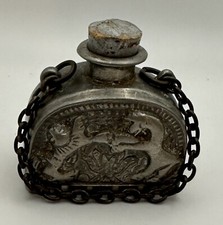 RARE & Vintage Aladin Rosine Silver Perfume Bottle 1919 by Paul Poiret
£358.90
RARE & Vintage Aladin Rosine Silver Perfume Bottle 1919 by Paul Poiret
£358.90
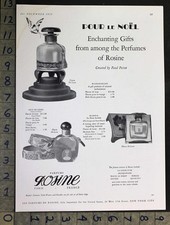 1928 ROSINE POUR LE NOEL PERFUME COLOGNE PAUL POIRET HEALTH BEAUTY AD FC14550
£34.95
1928 ROSINE POUR LE NOEL PERFUME COLOGNE PAUL POIRET HEALTH BEAUTY AD FC14550
£34.95
eBay listings may contain affiliate links. We may earn a commission from qualifying purchases.