In the early 20th century, a new artistic movement emerged in America which became known as American Modernism. This movement encompassed many different art forms, including architecture, painting, furniture design and interior design. One of the most notable furniture and interior designers of this time period was Karl Emmanuel Martin Webber (Kem Weber), a furniture and industrial designer, architect, art director, and teacher who created several iconic designs of the ‘Streamline’ style.
An Introduction to Karl Emmanuel Martin Webber (1889–1963)
Karl Emmanuel Martin Webber (also known as Kem Weber), a Berlin native who was trained by the royal cabinet maker Eduard Schultz in Potsdam before enrolling in the Kunstgewerbeschule (School of Applied Arts) in Berlin in 1908 to study under Bruno Paul, was born in Berlin in 1889. After receiving his diploma in 1912, Weber began working at Paul’s office after helping his professor build the German pavilion for the 1910 ‘Exposition Universalle’ in Brussels.

The second pavilion’s design ended up being the turning point in Weber’s career. Paul dispatched his assistant to San Francisco, California, to oversee construction of the German pavilion for the 1915 Panama-Pacific Exposition. Weber, though, was quickly eclipsed by different global events. Despite the pavilion’s construction being put on hold, the start of World War I stopped him from going home, leaving him trapped in California.
He moved to the USA and in 1921 he moved to Los Angeles and up 1924 until he worked as Art Director for Barker Brothers for whom he designed everything from furniture and interior fittings in a modernist style.
He became a US citizen in 1924 and took the name Kem based on the initials of his first three names (Karl Emmanuel Martin).

Weber then established an independent industrial design studio in Hollywood, where he also designed modern sets for films and private residences. His most important work is from 1927. The inclusion of his work in the 1928 ‘International Exposition of Art in Industry’ held by New York store Macy’s cemented his reputation and he went on to design many products including furniture, chairs, clocks and tablewarefor a wide variety of companies including Lloyd Manufacturing Company, Widdicomb, Berley & Gay, Friedman Silver Company, Porter Blanchard, The International Silver Company and Lawson Time.

Many of his designs can be classified as ‘Streamline Moderne’, such as: the copper ‘Zephyr’ desk clock by Lawson Time (1933); and ‘Airline’ chair (1934) which he later supplied to the Walt Disney Studios at Burbank in 1938 where he was chief architect and worked closely with Walt Disney; and the Lounge Chair made for the Lloyd Manufacturing Company. Kem Weber’s silver and silver plate designs were fully functional, often showing the influence of the Bauhaus design movement.

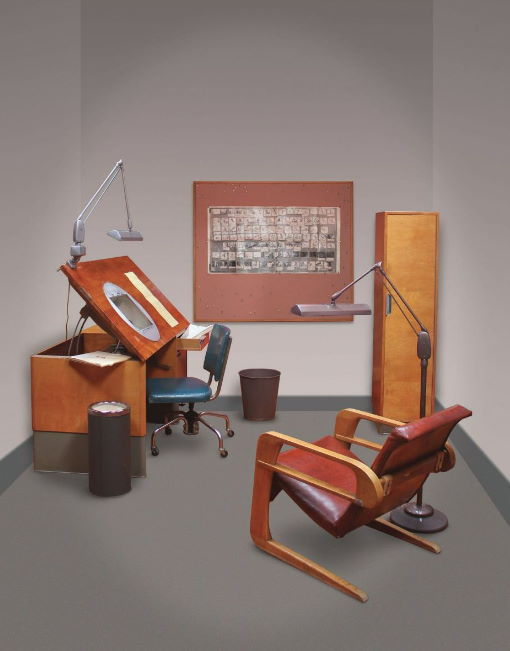
His creations are in high demand, and prices are steadily rising especially for his chairs and silver. His interior design work for Disney is in high demand and commands extremely high prices. Van Eaton Galleries in California have sold many Disney related items and in 2016 sold an incredible set of original Disney Studio animation office furniture designed by Kem Weber for a record $96,800. Included in the lot was an animator’s desk and animator’s disk, a closet (wardrobe), desk lamp, desk chair, floor lamp, extremely rare Kem Weber “Airline Chair”, trash can, and ashtray. The set together looks amazing. For more details visit Van Eaton Galleries.
The American Modernist movement
The American Modernist movement was an artistic and architectural exiting emergence in the early 20th century. In decorative arts, Modernism describes a period of design characterized by simplicity, functionality and minimal ornamentation. American Modernist designers were influenced by European design movements such as Art Nouveau and the Bauhaus. They sought to create products that were both beautiful and practical, with a focus on clean lines and geometric forms. American Modernism is often associated with the Arts and Crafts movement, which also emphasized craftsmanship and simplicity.
However, while the Arts and Crafts movement was focused primarily on traditional handcrafted objects, American Modernists used new technologies to mass-produce their designs. This allowed them to reach a wider audience and helped to popularize the Modernist style. Among the most famous American Modernist designers are George Nelson, Charles Eames, Raymond Loewy, Norman Bel Geddes. Their work has had a lasting impact on the world of design, and their legacy continues to influence contemporary artists and designers.