Collecting Communion Tokens and small Communion Tokens price guide. Communion tokens were round or oval in shape, and they were given to individuals who took communion in churches during the 17th, 18th, and 19th centuries. Presbyterian worship in Scotland is particularly associated with them, but they may also be found in England, the United States, Australia, Canada, New Zealand, Germany, the Netherlands, Switzerland.

The Communion tokens were used to identify those who were entitled to receive Communion. The minister would give the person a token before giving them Communion. When Communion was being given, the individual would show the token to the Communion steward.
There are a number of reasons why communion tokens were used. First, communion tokens ensured that only those who were members of the church and who had been properly instructed in the faith were able to receive Communion. This was important because Communion is a sacred act in which Christians partake of the body and blood of Christ. Second, communion tokens helped to prevent Communion from being taken by those who might not appreciate its significance or who might abuse it in some way. Finally, communion tokens served as a tangible reminder of an individual’s commitment to the Christian faith.
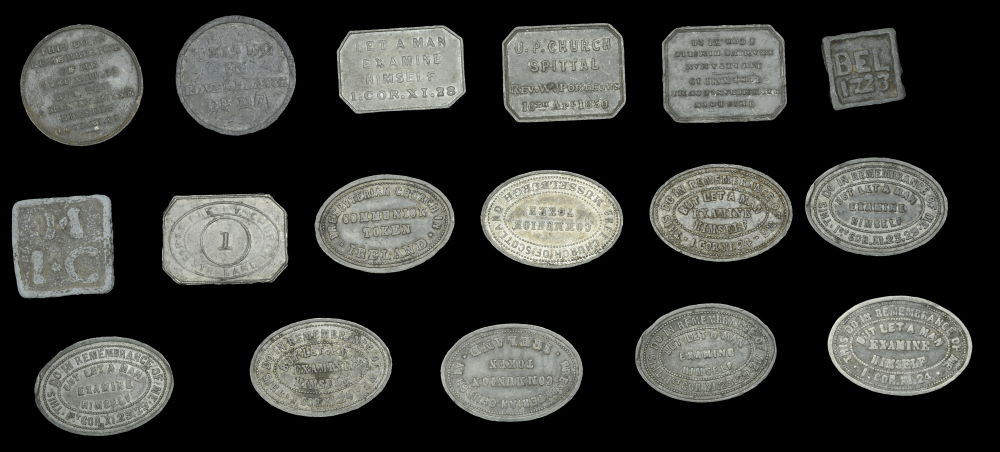
Though communion tokens fell out of use in the 18th century, they remain an important part of Protestant and Calvinist history. Communion tokens remind us of the importance of maintaining a proper understanding of Communion and of our commitment to the Christian faith.

They were also used as a means of identifying Communion members who had been away from the church for a period of time. They were also given to children when they were first admitted to communion.

Often, these tokens would be made of metal or other durable materials and would be worn around the neck or on a keychain. The most common materials were metal, wood, and bone. In some cases, Communion Tokens were also made of other materials such as stone or glass. They could have holes in the centre and so could be strung together.
Tokens were often engraved with a Christian symbol or the initials of the person who received the Communion Token. Communion tokens were collectibles even back then and people would try to get as many different ones as possible. There are many different types of communion tokens that can be found. Some have biblical scenes or symbols on them, while others have the name of the church or the year they were made. Messages on tokens would include biblical quotes such as ‘This Do In Remembrance of Me’ and ‘Let A Man Examine Himself’.
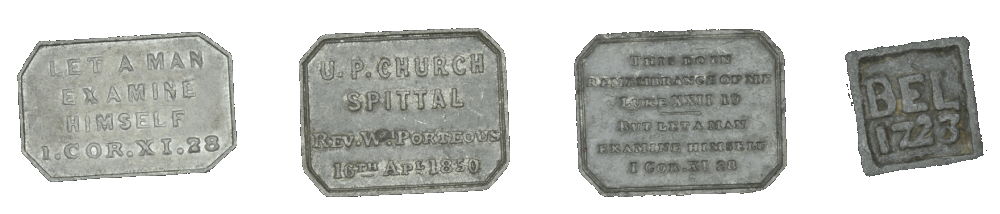
Today, they are still collected by some people as a hobby and for the most part can be acquired fairly inexpensively.
Related Collectibles on eBay
 FIRST COMMUNION Pocket Token
£5.99
FIRST COMMUNION Pocket Token
£5.99
 1819 Kilmalcolm Scottish Church / Communion Token Minister RC
£74.50
1819 Kilmalcolm Scottish Church / Communion Token Minister RC
£74.50
 Collection Of Nine C19th/18th Communion Tokens Scottish
£110.00
Collection Of Nine C19th/18th Communion Tokens Scottish
£110.00
 1834 Communion Token Trinity Parish Aberdeen Church Of Scotland Rare Collectable
£29.99
1834 Communion Token Trinity Parish Aberdeen Church Of Scotland Rare Collectable
£29.99
 English Free Church Inverness 1844 Communion Token - Scotland
£25.90
English Free Church Inverness 1844 Communion Token - Scotland
£25.90
 1845 Ellon Free Church Scottish Communion Token
£22.95
1845 Ellon Free Church Scottish Communion Token
£22.95
 1837 DRYFESDALE SCOTTISH CHURCH COMMUNION TOKEN VERY NICE COLLECTABLE CONDITION
£24.81
1837 DRYFESDALE SCOTTISH CHURCH COMMUNION TOKEN VERY NICE COLLECTABLE CONDITION
£24.81
 (ref288CE) Antique Communion Token Insch 1854 This do in remembrance of me
£9.99
(ref288CE) Antique Communion Token Insch 1854 This do in remembrance of me
£9.99
eBay listings may contain affiliate links. We may earn a commission from qualifying purchases.