The
The
rare 1970’s BBC Television Prop “The Dalek Supreme”
(aka The Tussaud’s Dalek) will be sold to benefit The Great
Ormond Street Hospital for Sick Children at Bonhams sale of
Rock n Roll & Film Memorabilia on Wednesday 16 November
2005.
Daleks were possibly the most popular on-screen villains created
by the entertainment industry. This unique prop, estimated at
£7,000-10,000.
The dalek naturally swivels with flashing lights, it has a
painted wooden body with plastic hemispheres and is mounted
with exterminator gun, suction arm and an articulated eye stalk
– preparation for the sale, it now also comes with a suitable
voice box to warn those in close in proximity of impending extermination.
Significantly, this actual model is the King of all Daleks,
having starred in period – painted in menacing black and
silver livery – as The Dalek Supreme. It was also the Dalek
used in the BBC-assisted display at Madame Tussaud’s Waxworks
Museum in the 1980 (finished in its current blue and silver)
and accompanied the figure of Dr. Who actor, Tom Baker.
It has developed a complex provenance of its own: In 1979,
four Daleks were required for the BBC Dr. Who story, Destiny
of the Daleks‚ starring Tom Baker. The BBC production unit
had no budget to build new props so had to make use instead
of three old 1960s Daleks along with four so-called Goon Dalek
props made for the filming of Planet of the Daleks‚ in
1973.
One original Dalek was butchered to provide moulds for vacuum-forming
more Dalek parts. Two of the four Goon props were in such bad
condition they were scrapped, and the base section of one of
the others was badly damaged. Consequently, the BBC unit found
itself with two 1960s Dalek props, one Goon‚ and only the
top half of another in useable condition.
The BBC had previously made an exhibition Dalek which was now
used to make up the shortfall. The good top half of the Planet
of the Daleks Goon‚ was then grafted on to the exhibition
Dalek skirt and so this Dalek was born! An interesting point
is that this evil entity was blown up‚ in Destiny of the
Daleks, by a pyrotechnic fire flash, the scorch marks still
remain visible under the prop’s interior seat. It was subsequently
repaired for future use.
After Destiny of the Daleks ‚ this prop passed to Madame
Tussaud’s Waxwork Museum to accompany the figure of Dr.
Who actor, Tom Baker. It was displayed there from 1980 until
summer 1981, painted in its unique blue, silver and black livery
in which it featured on the front cover of the Radio Times in
1983 for the 20th Dr. Who Anniversary.
No other Dalek was painted in these colours. The specific shade
– traced recently – is Porsche Riviera Blue and surprisingly
can apparently only be mixed to order. Meanwhile this prop’s
period on display earned it the name by which it has subsequently
become known – “The Tussaud’s Dalek”.
In February 1984, it was re-painted black with white hemispheres
to feature in Resurrection of the Daleks as the Dalek Supreme.
It was then featured in promotion for this story‚ having
been again painted in the standard dark grey of normal Daleks
in which form it had also appeared briefly during the fight
sequences in the last episode.
In March 1985 it made its final TV appearance, in Revelation
of the Daleks.
The Tussaud’s Dalek was sold in 1986 as part of a BBC
charity auction, for the Red Cross Sudan Appeal, to a private
UK Collection where it has remained since. Unfortunately it
had been only commercially refurbished for the Sale, losing
many original features and was painted an incorrect pale grey.
In 2004, following extensive research, it was painstakingly
restored to its correct Tussaud’s display form, with the
addition of a voice-box.
Distinguishing marks today:
1. The Tussaud’s Dalek skirt is block-board and ply, unlike
the other Daleks which wore fibreglass skirts.
2. The skirt has a similar angle at the back and front
3. The skirt has an extra lip around the bottom of the skirt
section
4. The hemispheres are 4.5-inches in diameter. All other Daleks
featured 4-inch diameter hemispheres.
5. The misalignment of the hemispheres is unique and makes this
Dalek easy to track from one story to another.
6. The shoulder section had four bolts around the oval until
it was refurbished in 1986 – the lower right bolt was larger
than the other three.
7. The Tussaud’s Dalek has three rows of bolt heads between
the hemispheres on the skirt. These were actually filled prior
to the refurbishment and have been subsequently reinstated.
For more details visit the Bonhams
web site.
Related Collectibles on eBay
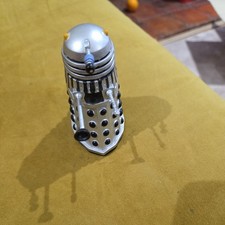 Dalek ('DEATH TO THE DALEKS') AYH 0223
£6.99
Dalek ('DEATH TO THE DALEKS') AYH 0223
£6.99
 DR WHO Black Dalek 2012 - 99 - BOXED - Collector's Model - AHN 4279
£25.99
DR WHO Black Dalek 2012 - 99 - BOXED - Collector's Model - AHN 4279
£25.99
 Doctor Who: Dalek Collector's Set 2 3 Daleks from 1964 to 1972
£95.00
Doctor Who: Dalek Collector's Set 2 3 Daleks from 1964 to 1972
£95.00
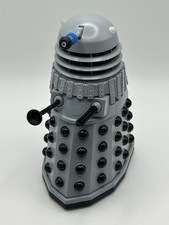 Doctor Who Dalek 'Destiny of the Daleks' Collectors' Set Underground Toys 5"
£40.00
Doctor Who Dalek 'Destiny of the Daleks' Collectors' Set Underground Toys 5"
£40.00
 DOCTOR WHO BBC HISTORY OF DALEKS 17 DALEK FIGURES LIMITED EDITION BRAND NEW
£250.30
DOCTOR WHO BBC HISTORY OF DALEKS 17 DALEK FIGURES LIMITED EDITION BRAND NEW
£250.30
 Dalek Sec Hybrid from the Doctor Who television series,
£21.24
Dalek Sec Hybrid from the Doctor Who television series,
£21.24
 Another Famous Doctor Who W008-10 Gold Dalek New Sealed
£83.90
Another Famous Doctor Who W008-10 Gold Dalek New Sealed
£83.90
eBay listings may contain affiliate links. We may earn a commission from qualifying purchases.